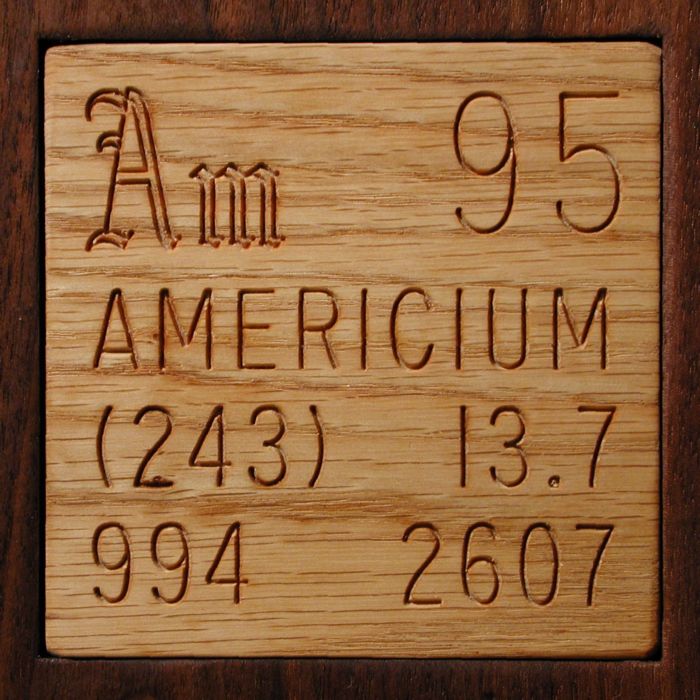
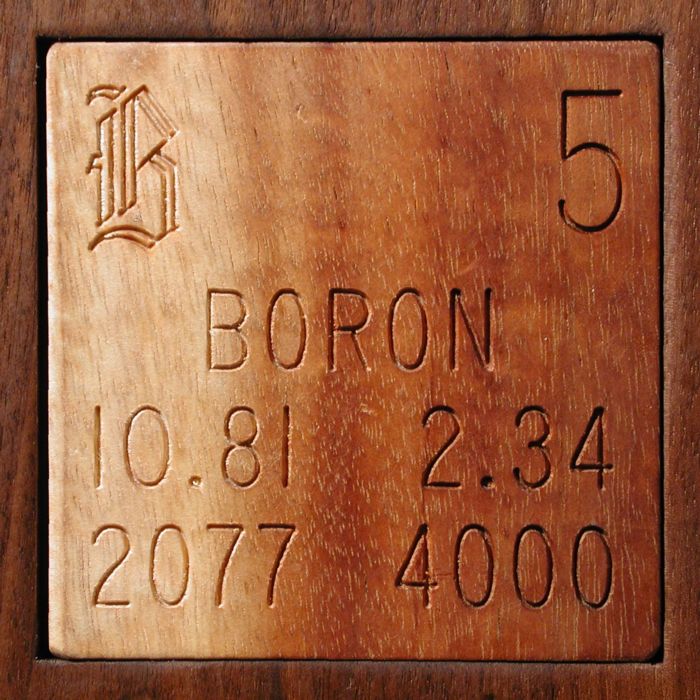
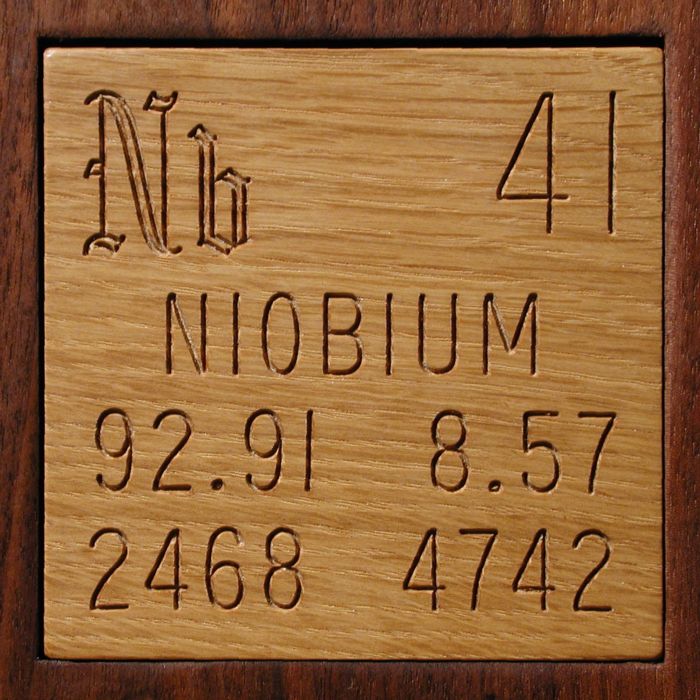
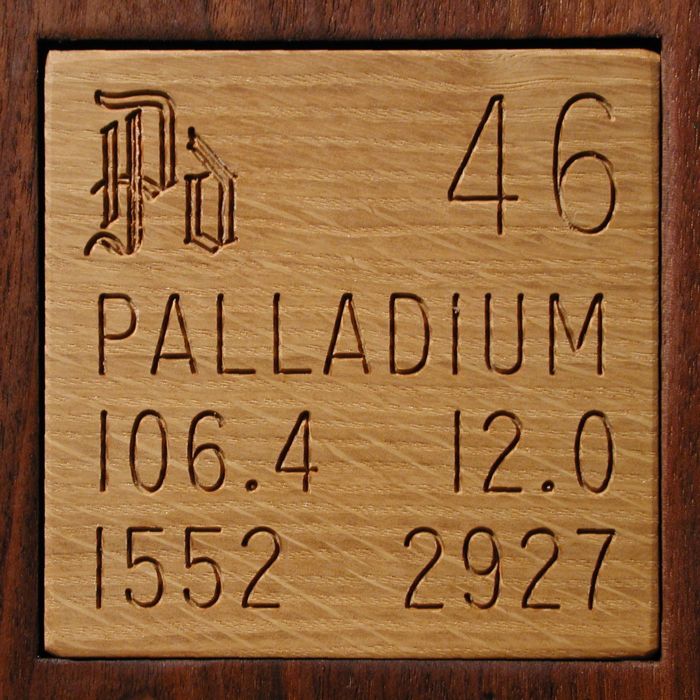
By Size of Largest Sample (74)

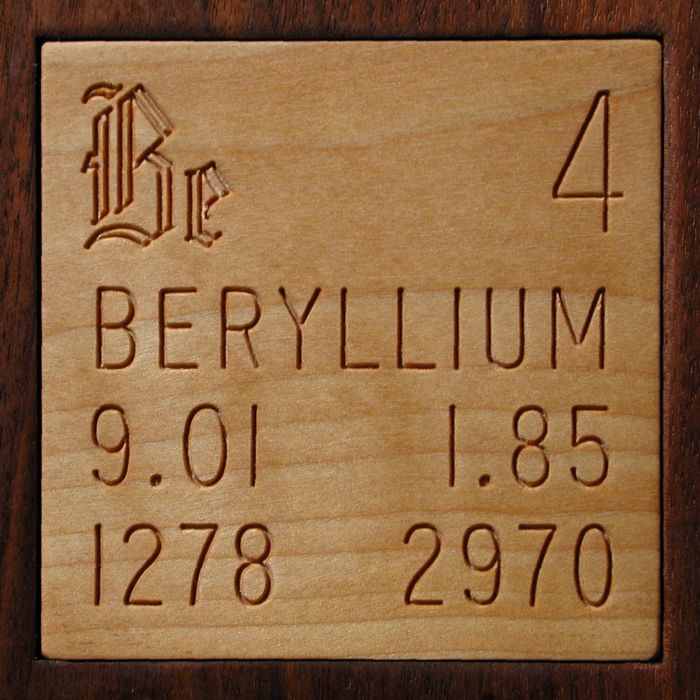
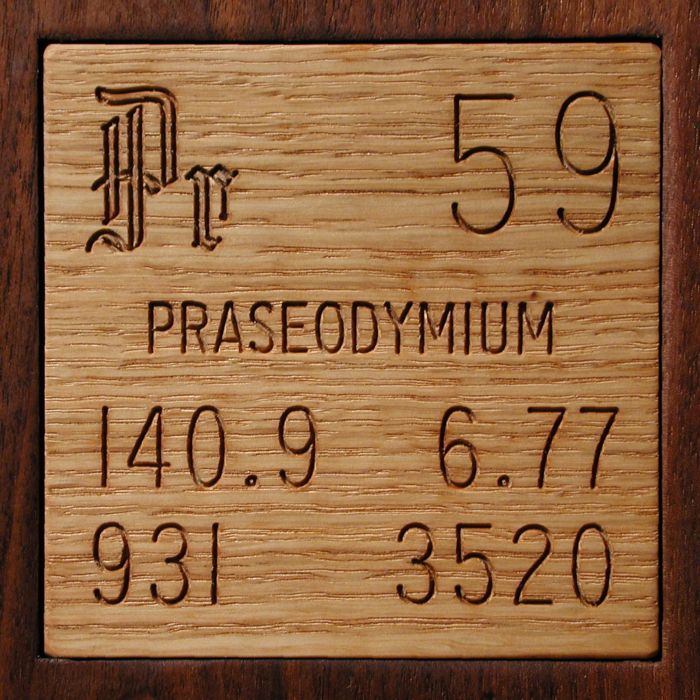
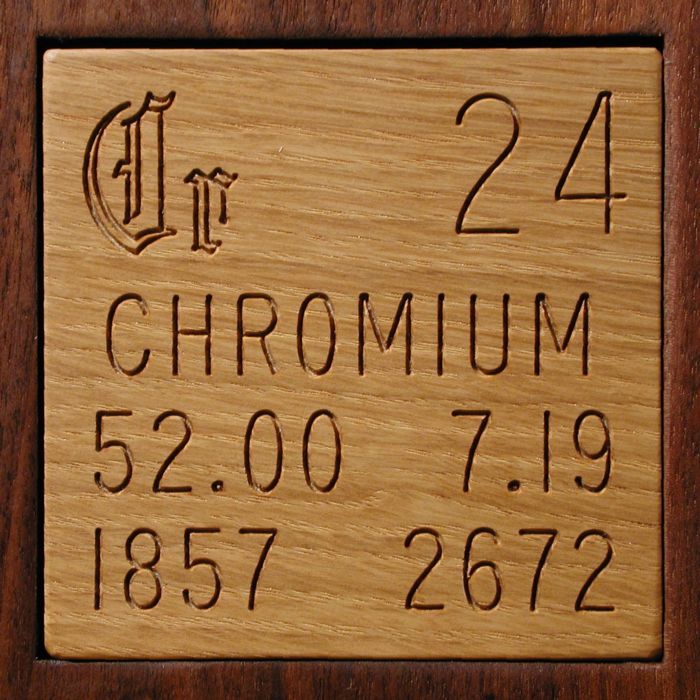
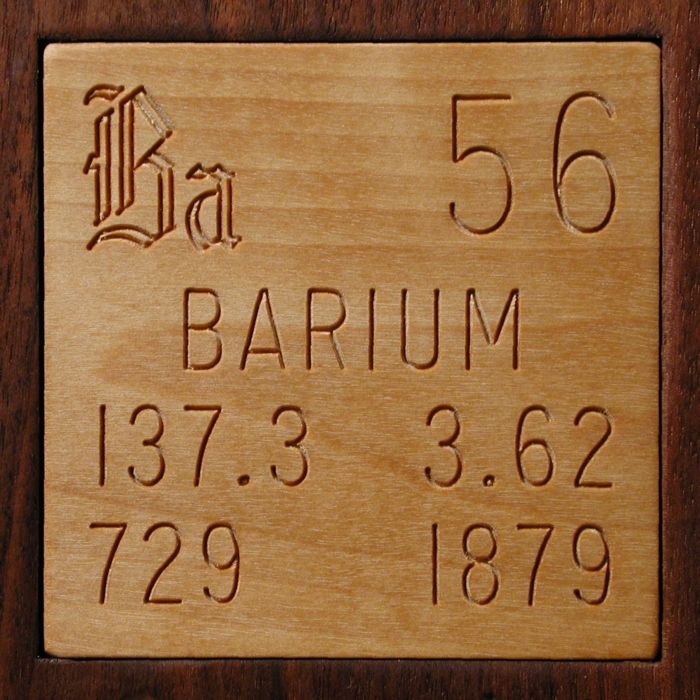
Here are the elements sorted in order of the size of the largest sample of each.
I currently have a total of 160 samples representing 74 different elements.

Be Sure to click on some of the sample pictures to see full size versions.
These sample pictures are some of the best you will see on the web.

(The full-size image will open in a separate window.)

Text and images Copyright (c) 2002 by Theodore W.Gray.

Back to Collections of Elements
Back to Periodic Table Home

Group:
Noble Gases
Collections:
Elements at Walmart
www.webelements.com
chemicalelements.com
Los Alamos
Royal Society
Environmental Chemistry
Phoenix College
Minerals
X-Ray Properties
Science Fiction Science Fiction Main
Comics
Poetry Poetry Main
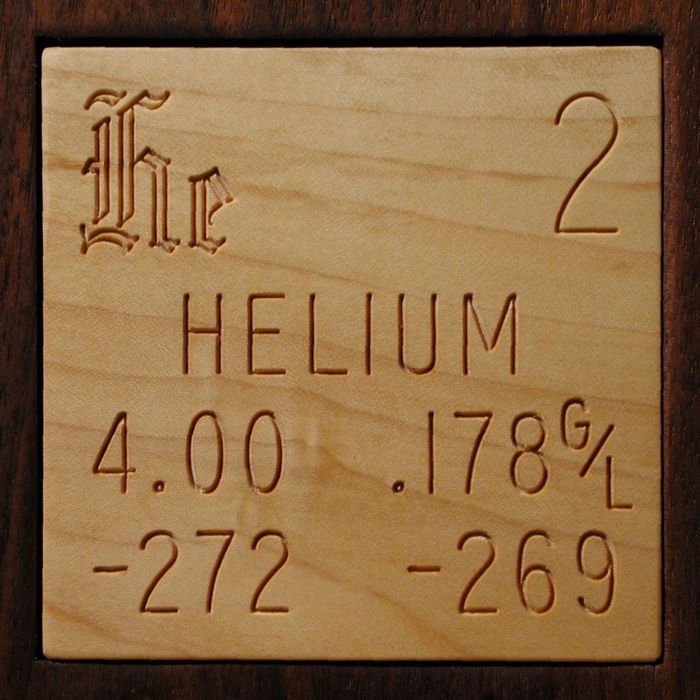
Disposable party balloon tank.
You can buy these lightweight tanks of helium at Walmart or any party supply store. They are thin-walled steel, not like the heavy gas cylinders used in welding, and only contain enough helium for about 30 balloons. On the plus side, they come with a supply of balloons and ribbon, so you're all set to entertain the kids with elements (at 75 cents a pop, so to speak).
Source: Walmart
Contributor: Theodore Gray
Date Acquired: 7 August, 2002
Price: $20
Size: 18"
Purity: >90%

Group:
Rare Earth Metals
Collections:
Favorite Samples
Elements with Sounds
Radioactive Elements
www.webelements.com
chemicalelements.com
Los Alamos
Royal Society
Environmental Chemistry
Phoenix College
Minerals
X-Ray Properties
Science Fiction Science Fiction Main
Comics
Poetry Poetry Main
M-735 Tank penetrating munition.
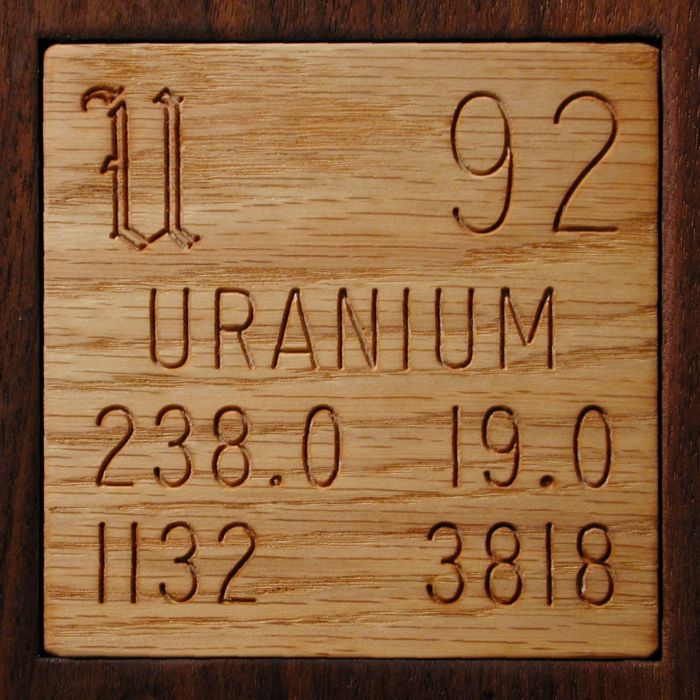
Armor piercing projectiles are generally made of depleted uranium, which is uranium metal from which most of the isotopes other than U-238 have been removed. The material is still somewhat radioactive, but not very.
Depleted Uranium is used for three main reasons. First, it's very, very dense, so at a given velocity it carries a lot of energy and hence penetrating force. Second, it's very hard, which of course also helps its penetrating effectiveness. Third, it's pyrophoric, which means it reacts chemically on impact causing an explosion inside whatever it's managed to penetrate.
There's a lot of controversy about the use of depleted uranium munitions, because people are afraid of the environmental effects on the countries that have been shot up with them. If they stayed intact there really wouldn't be much to worry about, and the radioactivity certainly isn't anything to worry about. But they don't stay intact, they vaporize on impact, and besides the trivial radioactivity, uranium is also a toxic heavy metal, sort of like mercury. Would you want someone to dump thousands of pounds of mercury in the countryside around you? Probably not. On the other hand, the number of people killed by uranium poisoning is probably, at a guess, significantly smaller than the number killed by whatever difficulty was causing their country to get shot up in the first place. It might be a more efficient use of ones efforts to worry about that than about the uranium dust that's left over.
A depleted uranium munition is the ultimate sample for a periodic table collection, because of the great difficultly in getting one. Unfortunately, I don't have one: This sample is only a practice round that contains no actual depleted uranium. Sniff. It weighs about 8 pounds, which might sound like a lot, but if it were real, it would be about to two and a half times heavier.
I've included the sound of a tank explosion with the kind permission of geekswithguns.com. I would have recorded one myself, but all my tanks are in the shop right now.
If you should happen to have a real depleted uranium round, please consider donating or selling it to me!
Source: Sovietski Catalog
Contributor: Theodore Gray
Date Acquired: 19 July, 2002
Price: $70
Size: 18"
Purity: 0%
Marbles.
Vaseline glass contains small amounts of uranium to give it the yellow color. You can find these kinds of marbles all over eBay from several different sellers. These two register just barely on our Geiger counter.
The sound for this sample is from the Geiger counter.
Source: Ed Pegg Jr
Contributor: Ed Pegg Jr
Date Acquired: 24 July, 2002
Price: Donated
Size: 0.5"
Purity: <5%
Death on the breakfast table.
Fiestaware was a very popular brand of ceramic tableware. Before the early 1940's the orange color of it was made with uranium in the glaze (uranium was used to get the color, not just accidentally). I think it's a good thing they stopped, because this thing is hot! It registers about 35,000 counts per minute, or almost 10 MREM/hour.
Listen to the sound for this sample and contrast it with the other radioactive samples (uranium marbles, thorium mantle, americium smoke detector). This one has that "let's get out of here now before we fry" ring to it.
To give a sense of how much radiation this is, if you held it in close proximity for 10 hours, you would double your yearly background radiation dose. If you kept it close for 20 days, you would have exceeded the yearly occupational exposure limit for nuclear power plant workers.
I don't know about you, but I wouldn't want to eat out of it.
Coincidentally right after it arrived, I came across an opportunity to scavenge about 3/4 of a ton of lead shielding from an abandoned hospital x-ray room. (I could have had the CAT scan machine too, but it was too big.) So I melted some down and made a 40 pound containment bowl to hold this little orange bowl. Overkill, yes, but then isn't this whole project just one huge case of overkill? You can see the lead bowl under lead.
Source: Charles and Susan Kunze
Contributor: Charles and Susan Kunze
Date Acquired: 30 July, 2002
Price: Donated
Size: 5"
Purity: <5%
50 calibre armor piercing shell. Real depleted uranium this time, I hope.
I've been looking hard for depleted uranium shell, and here they are! Hopefully! The hopefully uranium is made visible in the one where the copper cladding has been cut away on a lathe. It does not register on my Geiger counter, but the consensus of opinion of people who probably should know is that it wouldn't be expected to. Still, I have no real proof yet that it is uranium.
For your edification, I've included the sound of a 50 calibre rifle with the kind permission of geekswithguns.com.
Despite repeated efforts to determine it, I frankly don't know whether possession of these things is legal or not. Since they have been thoroughly decommissioned by removing of the cladding and cartridge, they are certainly not a weapon anymore, and my reading indicates possession of up to 15 pounds of un-enriched uranium is legal, so hopefully I'm on safe ground. However, if you're the FBI and I'm not on safe ground, please take into consideration that the non-machined one actually doesn't contain a uranium core (note lack of black painted tip). It looks identical to what the other one looked like before being machined. And the machined one is clearly not functional anymore.
Source: eBay seller accurateimage@yahoo.com
Contributor: Theodore Gray
Date Acquired: 31 July, 2002
Price: $10/each
Size: 2.5"
Purity: >80%

Group:
Non-Metals
Collections:
Elements with Sounds
Fun/Dangerous Experiments
Elements at Walmart
Elements in the Human Body
Elements that spell OLiVEr SAcKS
www.webelements.com
chemicalelements.com
Los Alamos
Royal Society
Environmental Chemistry
Phoenix College
Minerals
X-Ray Properties
Science Fiction Science Fiction Main
Comics
Poetry Poetry Main
Natural sample, 21% Pure.
I collected this sample of naturally occurring air (21% pure oxygen) from about 20 feet away from the table in May, 2002. The sound for this sample is a beautiful 78% nitrogen, 21% oxygen wind sound borrowed from ftp://ftp.zib.de/pub/UserHome/Luegger/Urania/Sound/FX-03.WAV .
Source: Air
Contributor: Theodore Gray
Date Acquired: 18 May, 2002
Price: $0/Free like the air we breathe
Size: 2.5"
Purity: 21%
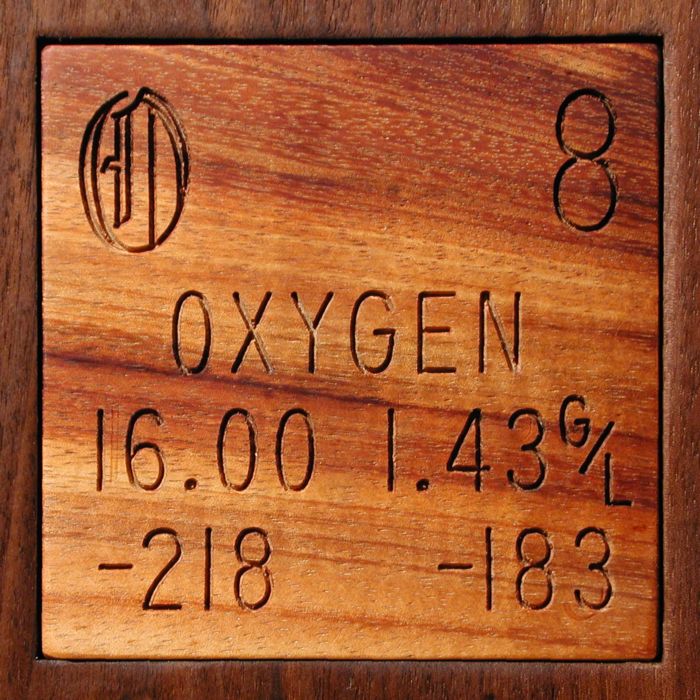
Mini welding gas cylinder.
Cylinders like this are sold in any hardware store for use with small welding/brazing torches. They are nothing like the heavy, thick-walled oxygen cylinders used with real welding torches. But they are cheap and do contain actual oxygen.

Many people don't realize that when you use an oxy-acetylene cutting torch to cut steel plate, the acetylene is just there to get things started. Once the steel is hot enough, you turn off the acetylene and blow pure oxygen at the advancing cut. The oxidation (burning) of iron in pure oxygen releases enough heat to keep the reaction going, and a jet of high pressure oxygen can literally burn through four inch thick solid steel plate.
I learned this from Harry Barnhart, a thinking farmer who showed me how it's done one day many years ago.
Because the air around us is only about 21% oxygen, steel will burn in air, but it won't generate enough heat to keep the burning going unaided. In air, the steel will cool down and stop burning pretty quickly unless you give it extra heat. This is the principle of the plasma-arc cutting torch (pictured under hafnium), which uses just electricity and air to cut steel. As when you turn off the acetylene in an oxy-acetylene torch, the steel itself is the fuel that powers the cutting action, but without pure oxygen to energize things, the plasma-arc cutter has to use an electric arc to supply the necessary extra heat.
Source: Hardware Store
Contributor: Theodore Gray
Date Acquired: 5 August, 2002
Price: $5
Size: 12"
Purity: >95%

Group:
Transition Metals
Collections:
Favorite Samples
Elements with Sounds
Elements at Walmart
www.webelements.com
chemicalelements.com
Los Alamos
Royal Society
Environmental Chemistry
Phoenix College
Minerals
X-Ray Properties
Science Fiction Science Fiction Main
Comics
Poetry Poetry Main
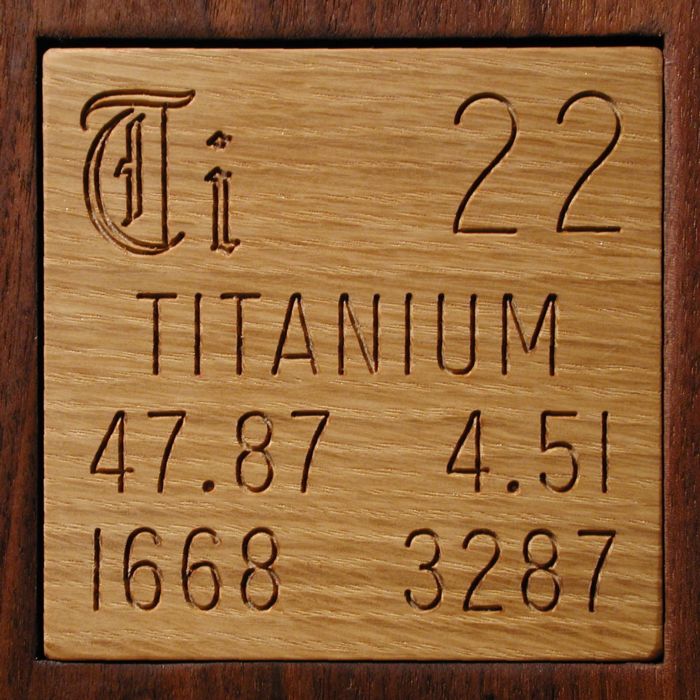
Cylinder, Sponge, and Mossy, 99.98%.
Kindly donated by David Franco, who sent many elements after seeing the slashdot discussion.
Source: David Franco
Contributor: David Franco
Date Acquired: 17 May, 2002
Price: Donated
Size: 0.1"
Purity: 99.98%
Machined part, 99.999%.
This lovely if perplexing shape of "five nines" titanium was kindly donated by Ivan Petrov, of the Materials Research Laboratory at the University of Illinois. I had gone there to have my artificial knee joint sample tested to see what it was. It turned out to be Aluminum instead of the hoped for titanium. I guess he took pity on me by donating a couple of nice pure metals.
Source: Ivan Petrov
Contributor: Ivan Petrov
Date Acquired: 6 June, 2002
Price: Donated
Size: 3"
Purity: 99.999%
Electrochemically grown crystals.
These crystals were reported to have been grown in a factory some time ago. I don't know much more about them, but they are heavy, shiny, and titanium-like. A few are about an inch long, the rest crumbled.
Source: eBay seller snooj
Contributor: Theodore Gray
Date Acquired: 11 June, 2002
Price: $13
Size: 1"
Purity: >99%
Intramedullary nails.
Paul Wellin's brother is an orthopedic surgeon. I know this because I was talking to Paul about how I hoped some day to meet an orthopedic surgeon who would have some left over body parts made out of titanium or tantalum that he could donate to my periodic table, upon which Paul said....
These bone pins were defective in some way, though they look rather pretty to me. They are over twelve inches long. Think about someone cutting open your body, drilling out the marrow of your bones and the ramming one of these things the whole length through, so they can screw some fittings on either end. Ouch. But at least you'll have some very attractive titanium in you from then on.
Paul Wellin's Brother sent the following information about these samples:
"Titanium has become a preferred material for Orthopedic implants over the past 10-15 years because of a number of its inherent properties. It is inert in the body, and has sufficient strength to support the mechanical loads (assuming proper design and size of the implant). It is also very resistant to fatigue failure - that is, it can undergo many (millions) of cycles of mechanical loading without failure - a property that is extremely important in an Orthopedic implant that will be subjected to a million cycles of loading a year. Most Orthopedic titanium implants are actually an alloy of titanium with small amounts of aluminum and vanadium, as pure titanium implants are somewhat brittle and have a higher rate of fracture. Titanium alloy is less brittle, and holds up quite well."
"As to why the implants you have are not in someone's body, they are not defective; they were actually in the operating room and taken out of their sterile packaging in anticipation of being implanted, but were for one reason or another not used. In some cases, the devices were implanted, but found to be too long or too short, and were then replaced with a correct sized implant. We are not allowed to re-use devices that have been implanted and removed, as there is no feasible way to ensure that the stresses of implantation have not altered the mechanical properties of the device. So they become very expensive junk. (Any implant that was removed from a patient was thoroughly cleaned and then sterilized before it left the OR). Other devices may have been removed from their packaging, but not implanted because the surgeon changed his/her mind about the size or decided to use a slightly different implant before actually putting in the patient. Depending on the implant, re-sterilization in the hospital may not be practicable - more expensive junk."
"These intramedullary rods or nails are placed inside the intramedullary canal (marrow cavity) of long bones like the femur or tibia to stabilize fractures of these bones until they heal."
Source: Paul Wellin
Contributor: Paul Wellin
Date Acquired: 14 June, 2002
Price: Donated
Size: 12"
Purity: >95%
Hip joint socket.
This is the other half of an artificial hip joint you can see under cobalt, the socket into which the ball from that part fits into. The outer surface is a wonderful matrix of sintered titanium balls (very small), for the hip bone to grow into, firmly attaching the socket to the bone.
Source: Paul Wellin
Contributor: Paul Wellin
Date Acquired: 14 June, 2002
Price: Donated
Size: 2.25"
Purity: >95%
Gibraltar Millennium Coin.
I have a feeling this is one of those coins that isn't actually meant to be spent. Its face value is 5 Gibraltar Pounds, whatever that's worth. I paid $35 for it. It's one of only a very small number of coins that's ever been minted out of titanium, probably because the stuff is pretty hard to work with, and most people wouldn't appreciate the advantages of coinage you could build a jet engine out of.
Dan Lewis, the source of this coin, sent the following story about it:
The titanium coins were minted for Gibraltar by the Pobjoy Mint in the UK. Only 2001 of them were produced, and I think they have kind of given up on making more titanium coins because the hardness of the metal makes it very difficult to work with, not to mention how quickly it destroys the dies. They did issue one other Five Pound coin in the year 2000, this one to commemorate the famous "Tuppenny Blue" postage stamp, which is currently valued at $800,000. I think they were already committed to minting the second coin before they figured out what a pain it would be to produce coins from titanium.
Source: Dan Lewis
Contributor: Theodore Gray
Date Acquired: 14 June, 2002
Price: $35
Size: 1.5"
Purity: >99%

Group:
Other Metals
Collections:
Favorite Samples
Elements with Sounds
Fun/Dangerous Experiments
Elements at Walmart
www.webelements.com
chemicalelements.com
Los Alamos
Royal Society
Environmental Chemistry
Phoenix College
Minerals
X-Ray Properties
Science Fiction Science Fiction Main
Comics
Poetry Poetry Main
Plumbing lead.
I purchased several 10lb bars of plumbing lead from a hardware store probably in the early 1990s. It's still available in this form so far as I know.
I asked Jim Zimmerman to use a cold chisel to chop off a lump of one of the bars and pound it into a nice primitive-looking lump. (Sawing it off would have generated poisonous lead dust.)
Source: Hardware Store
Contributor: Theodore Gray
Date Acquired: 15 April, 2002
Price: $1/pound
Size: 2.5"
Purity: >95%
9mm bullets.
I plucked these off some 9mm rounds I got in California many years ago. But you can pretend they were used in a bank robbery or something, it that makes them seem more interesting. The copper color comes from a thin plating of copper, but inside it's all hot lead.
The sound for this sample is a nice shot borrowed from da-admiral.com.
Source: Gun Shop in California
Contributor: Theodore Gray
Date Acquired: 15 April, 2002
Price: $0.20/bullet
Size: 0.5"
Purity: >95%
"Atomic Potluck"
This is art, ok? It's a bowl with a cloth thrown over it, just like a housewife in the 1950's would take to the potluck block party. Except it's made out of 40 pounds of lead, and we use it as a containment vessel for our highly radioactive Fiestaware bowl (see uranium), which is also exactly the kind of thing a 1950's housewife would take to the potluck.
I came into the lead for it when I had an opportunity to scavenge about 3/4 of a ton of lead shielding from an abandoned hospital x-ray room. (I could have had the CAT scan machine too, but it was too hard to move.)
I was scheduled to tour this abandoned hospital with a developer (who is trying to sell my company on the idea of moving to the office complex he's going to build after demolishing the hospital), and I had actually planned to stop by the hardware store on the way back to work to pick up a few bars of lead, because I needed some to make some kind of enclosure for the Fiestaware. I thought 10 pounds would do (and it would have).
But that plan obviously changed after I saw the huge quantities of lead in the x-ray room. A single sliding door (which we were ultimately unable to recover) had at least 1500 pounds of lead in it (6 by 8 feet by 1/2 inch thick).
The day after the tour Ed Pegg, Jim, and I went in with sledge hammers, nail pullers, lanterns, and of course permission, to see how much lead we could mine. It came in two forms, 1/8" thick sheets about 2 by 4 feet: Ed and Jim smashed the drywall covering them and un-nailed about 15 sheets from the wall. And 1/2" thick plates about one foot square, covered over in thin cinderblocks: I smashed out 22 of them, each weighing 36 pounds.
In two hours we had a lifetime supply of lead.
I melted down one of those thick plates in a medium-sized stainless steel mixing bowl, then used some wood blocks to press the next smaller size of bowl down into the molten lead, pressing it into the space between the two sizes of bowl. Thus was formed the bowl part of "Atomic Potluck".
For the lid I simply traced out a circle somewhat larger than the bowl on one of the thin sheets, cut it out with tinsnips, then used my (now sore) thumbs to flute the edges artistically.
Both parts are heavily varnished to prevent lead transfer to people touching them (though I'd still never store food in it).
Source: Theodore Gray
Contributor: Theodore Gray
Date Acquired: 31 July, 2002
Price: Donated
Size: 9"
Purity: >95%
"Atomic Potluck II"
Flushed with the success of "Atomic Potluck", I made another one as a thank you for Ed, for helping extract the lead on a very hot day. This one has more of a traditional pot lid: I made the handle by bending a bar of lead into the right shape and then setting it into the lid when it was still molten.
Source: Theodore Gray
Contributor: Theodore Gray
Date Acquired: 3 August, 2002
Price: Donated
Size: 9"
Purity: >95%
"Doorstop No. 1"
There's just something about mass quantities of mass in small packages. This is about 50 pounds of lead (one and a half of the thick tiles discussed above) melted into a bowl and simply left to cool after carefully skimming the surface. The bowl was the same one used to form the inner surface of the Atomic Potluck series, so you could set this object into an Atomic Potluck bowl and have a compound lump that would weigh more than many supermodels, while not taking up much more space than one of their ... um ... handbags.
Source: Theodore Gray
Contributor: Theodore Gray
Date Acquired: 18 August, 2002
Price: Donated
Size: 8"
Purity: >95%

Group:
Transition Metals
Collections:
Favorite Samples
Elements with Sounds
Elements at Walmart
www.webelements.com
chemicalelements.com
Los Alamos
Royal Society
Environmental Chemistry
Phoenix College
Minerals
X-Ray Properties
Science Fiction Science Fiction Main
Comics
Poetry Poetry Main
Surplus 11 pound metal cylinder.
Purchased from Neil Lipson (Lipson@postoffice.att.net) after contact through eBay. Said to originate from a company closure.
This is by far the most tactile sample in the collection: People just can't put it down, because it's so darn heavy. I always point out that it's almost exactly the same density as gold, so holding this lump is as close as you're likely to come to the experience of holding about $50,000 (at $350/troy ounce) worth of gold.
I had a suspicion that it was probably not pure tungsten. Research on the internet indicated it was probably about 97% tungsten, 1% iron and 2% nickel. The iron and nickel are mixed with tungsten powder and the mixture heated under great pressure to fuse the iron-nickel alloy into a matrix around the tungsten particles.
Through the good graces of Inga Karliner of the University of Illinois physics department I was put in contact with Ivan Petrov of the U of I's materials research department, which just happens to be a national collaborative center for materials testing, which means they have a hallway with something like two dozen very fancy instruments for telling me what my tungsten cylinder is made of. (I was pleased that even at a national collaborative center for materials testing my tungsten cylinder was considered interesting and heavy.)
Petrov's colleague Jim Mabon confirmed my guess with a quantitative analysis by x-ray fluorescence spectroscopy;
96.32% tungsten
1.23% Iron
2.45% Nickel
Source: Neil Lipson
Contributor: Theodore Gray
Date Acquired: 29 May, 2002
Price: $315
Size: 3"
Purity: 96.3%
Bar of 99.99% tungsten.
Ivan Petrov (see above cylinder sample discussion) kindly donated a couple of very pure metal samples, including this lovely machined bar of "four nines" tungsten. It looks like powder metallurgy origin to me, but he didn't know for sure.
When NPR's Science Friday program asked to interview me about the Periodic Table Table, I decided to record "the sound of sintered tungsten", as mentioned in Uncle Tungsten. Oliver Sacks has actually listened to this recording and confirms that it's the kind of sound his uncle was talking about. (Wow, how authentic can you get!) Click the speaker icon to hear the sound of tapping this bar with a mallet.
Source: Ivan Petrov
Contributor: Ivan Petrov
Date Acquired: 6 June, 2002
Price: Donated
Size: 4"
Purity: 99.99%
Welding electrode.
Rods of solid tungsten from 1/16 to 1/8 inch diameter and 3-7 inches long are used as electrodes in certain kinds of arc welding. Claudin Welding Supply kindly donated one when I went there looking for Hafnium.
Source: Claudin Welding Supply
Contributor: Claudin Welding Supply
Date Acquired: 24 July, 2002
Price: Donated
Size: 7"
Purity: >95%
Fine wire.
This is really, really fine tungsten wire: 0.0025 inches diameter. It's quite strong, but what's really surprising as usual is how heavy the spool is. I need to figure out something to do with it, like hang a picture, because I've got 5000 feet of it.
Source: eBay seller 7890inky
Contributor: Theodore Gray
Date Acquired: 23 July, 2002
Price: $22
Size: 2.5"
Purity: >99%
Cubes, 99.99%.
These are just rough cubical chunks, quite small, of quite high-purity tungsten. Nice and heavy as usual. Pointy too.
Source: eBay seller aaronleighton
Contributor: Theodore Gray
Date Acquired: 9 August, 2002
Price: $12
Size: 0.4"
Purity: 99.99%

Group:
Transition Metals
Collections:
Elements with Sounds
Elements in the Human Body
www.webelements.com
chemicalelements.com
Los Alamos
Royal Society
Environmental Chemistry
Phoenix College
Minerals
X-Ray Properties
Science Fiction Science Fiction Main
Comics
Poetry Poetry Main
Anode button.
Purchased from Neil Lipson (Lipson@postoffice.att.net) after contact through eBay. I'm very unclear on what process this odd item was a result of, but clearly electro-accumulation is a reasonable claim. It's quite peculiar.
Source: Neil Lipson
Contributor: Theodore Gray
Date Acquired: 29 May, 2002
Price: $5
Size: 1.25"
Purity: >99%
Another anode button.
This one was donated by David Franco in exchange for Mathematica T-shirts. It's similarly peculiar.
Source: David Franco
Contributor: David Franco
Date Acquired: 11 June, 2002
Price: Donated
Size: 1.25"
Purity: >99%
Top of knee joint.
This is the top of an artificial knee joint: I've removed the plastic block that attaches just underneath this metal part, and which mates with the double-ball of the other half, which you can see under aluminum. Unfortunately they seem to be a different brand or something because the parts don't fit each other.
I originally thought these were
titanium, but the source, Paul Wellin's Brother, reports as follows:
"The top of knee joint and the hip joint ball attachment are probably made of a different alloy, cobalt-chrome, for increased strength and decreased flexibility as compared to titanium."
I don't know whether there is more cobalt or more chromium in the alloy, so I've somewhat arbitrarily chosen to put them under cobalt.
Source: Paul Wellin
Contributor: Paul Wellin
Date Acquired: 14 June, 2002
Price: Donated
Size: 2.5"
Purity: <60%
Hip joint ball attachment.
This is the part of an artificial hip which is inserted into the long bone of the leg, whatever that's called. Then a ball screws onto the end of it. The middle section is coated with some kind of rough probably ceramic surface, to encourage bone to grow into and attach to it. The ball fits into a socket which you can see under titanium.
Source: Paul Wellin
Contributor: Paul Wellin
Date Acquired: 14 June, 2002
Price: Donated
Size: 5"
Purity: <60%

Group:
Other Metals
Collections:
Elements with Sounds
Fun/Dangerous Experiments
Elements at Walmart
www.webelements.com
chemicalelements.com
Los Alamos
Royal Society
Environmental Chemistry
Phoenix College
Minerals
X-Ray Properties
Science Fiction Science Fiction Main
Comics
Poetry Poetry Main
4/0 electrical wires.
This was from heavy-gauge electrical wire left over from when we added the round house at the farm. It's been melted down and allowed to cool in the standard graphite crucible used for many metal samples. It came out very ugly, so I used a grinder, table top belt sander, and wire brush in the drill press to machine it into a cleaner cylinder with a pleasing texture on the surface.

The globular stuff is what happens if you pour molten aluminum into a deep bucket of water. You can pour any kind of molten metal into water and each kind will give you different shapes. The shapes depend on how high you pour from, how much above its melting point the metal is, and how deep the water is. According to certain traditions, the shapes also depend on your fate, hence can be used to predict it (most traditions specify lead, but I don't see any reason why aluminum would be less likely to work for this purpose).
Any time you combine water with molten metal, there is a danger of the metal splattering. Generally speaking, if you pour metal into a reasonably full bucket of water, it sinks and cools too fast for any to splatter back at you (which is not to say it can't happen, so use a face shield). But if you pour (or even drip) water into a container of molten metal, it's a different story: That is quite likely to cause a steam explosion that throws liquid metal all over. So when you're pouring metal into water, the biggest danger is if any water happens to splash back into the bowl you're pouring out of. Pour away from you, so the bowl is between you and the metal, don't lean over it while you're pouring, and wear thick clothes and sturdy shoes along with a face shield or at least glasses. (I should talk: I made these lumps barefoot in shorts and no shirt. It's OK because I'm a trained professional idiot. And no matter what other precautions I don't take, I would never do this without glasses on. I can risk missing a few square inches of skin, but not missing an eye.)

I got the wire from a building center in the mid 1990s.
Source: Hardware Store
Contributor: Theodore Gray
Date Acquired: 15 April, 2002
Price: $1/foot
Size: 1.25"
Purity: >95%
Gem cut aluminum oxide (corundum).
These are real rubies and sapphires purchased from http://www.pehnec.com in April 2002. Real because they are chemically and crystallographically indistinguishable from naturally occurring gems (that would cost well into 5 figures). Present in the table because they are man-made (real, but synthetic).
Source: Pehnec Gems
Contributor: Theodore Gray
Date Acquired: 23 April, 2002
Price: $15/both
Size: 0.6"
Purity: <50%
Artificial knee joint (practice version).
After starting to collect elements I researched industrial uses of pure elements in search of products I might be able to get as samples. For titanium and tantalum a promising source seemed to be artificial body parts, since these are the only two elements used for that purpose, because they are unreactive with human body fluids. I joked to my long suffering colleagues that all I needed to do was find the right body to dig up. I think they were worried.

And of course not two days later I found an eBay listing for a human tibia with attached artificial knee joint. (There is nothing you can't buy on eBay) The dealer seemed to be a legitimate outfit in Berkeley, California, and they indicated they thought it was probably titanium. I secretly hoped it was tantalum, which would have made it worth a serious amount of money.

I won the auction for $31, which seems like a very fair price for half of someone's leg. (This would, by the way, set the price for an arm and a leg at approximately $120, a real bargain.) But doubt remained as to the true identity of the metal. According to the seller, this item had been made by the manufacturer of the artificial knee for use in training surgeons in the use of that company's special drills and tools. I hope they learned well, because it's got several cuts on it where it looks like someone slipped....

Since it was never meant to be implanted into a living person, I was worried they might have saved some money by using a cheaper alloy. I was right to worry. Through the good graces of Inga Karliner of the University of Illinois physics department I was put in contact with Ivan Petrov of the U of I's materials research department, which just happens to be a national collaborative center for materials testing, which means they have a hallway with something like two dozen very fancy instruments for telling me what my knee joint is made of.

Dr. Petrov's colleague Jim Mabon confirmed my fears with a quantitative analysis by x-ray fluorescence spectroscopy:
99.78% Aluminum
0.109% Iron
0.0062% Nickel
0.0053% Copper
0.0257% Zinc
In other words, common aluminum casting alloy. Interestingly, there was a 0.074% trace of titanium, which makes me think it was probably cast in the same mould, or maybe the aluminum was melted in the same crucible, as the titanium parts used on living people. There was not so much as the slightest detectable trace of tantalum.

Oh well, by then I'd become attached to my little bone, and it will have a place of honor under aluminum. After all, this was someone's leg, maybe someone's daddy's leg, and it deserves respect. (It is claimed to be a pre-1987 leg from India.)
Source: The Bone Room
Contributor: Theodore Gray
Date Acquired: 13 May, 2002
Price: $31
Size: 4"
Purity: 99.78%
So-called "Titanium" racket.
"Racket" may be the right word for this sample, which used to be a racketball racket prominently labeled as "TITANIUM". If it were titanium, it wouldn't have melted at about 700C in my crucible of truth.
Source: Chris Carlson
Contributor: Chris Carlson
Date Acquired: 10 June, 2002
Price: Donated
Size: 1.25"
Purity: >95%
Fine powder, 99.999%.
Kindly donated by David Franco, who sent many elements after seeing the slashdot discussion, and this one after I sent him some Mathematica t-shirts.
Source: David Franco
Contributor: David Franco
Date Acquired: 11 June, 2002
Price: Donated
Size: 0.2"
Purity: 99.999%
Tiny cylinder.
Ed bought half a dozen different tiny metal cylinders from David Franco, intending to make some kind of puzzle out of them (Ed's a puzzle person). But they turned out to be too irregular, so he donated them to the table.
Source: David Franco
Contributor: Ed Pegg Jr
Date Acquired: 19 August, 2002
Price: Donated
Size: 0.2"
Purity: 99.99%

Group:
Metalloids
Collections:
Favorite Samples
Elements with Sounds
Elements at Walmart
Elements in the Human Body
www.webelements.com
chemicalelements.com
Los Alamos
Royal Society
Environmental Chemistry
Phoenix College
Minerals
X-Ray Properties
Science Fiction Science Fiction Main
Comics
Poetry Poetry Main
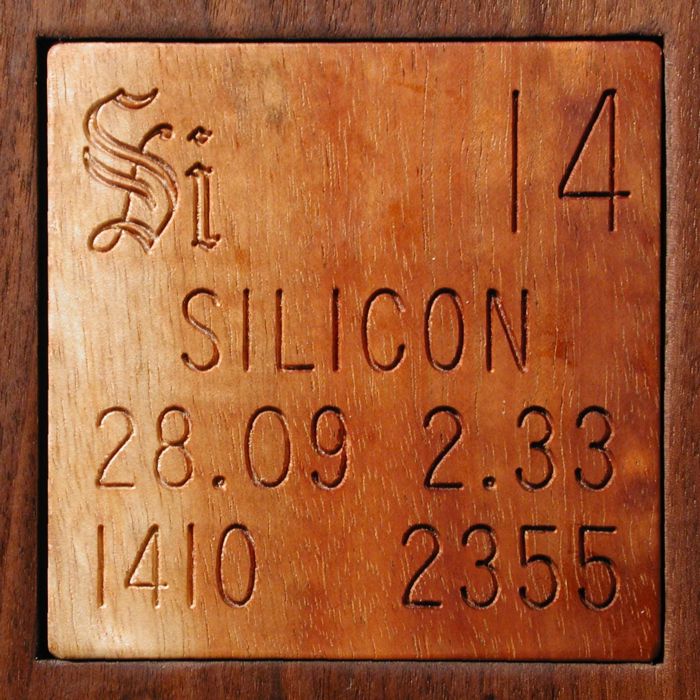
Silicon wafer.
These are broken pieces of etched silicon wafer purchased at the Tech Museum in San Jose, in the late 1990s. No idea what chips are on the wafer.
Source: The Tech Museum, San Jose, California
Contributor: Theodore Gray
Date Acquired: 15 April, 2002
Price: $20/unbroken wafer
Size: 1.5"
Purity: 99.9999%
Silicon Boule Top.
This is the cut-off top of a cylindrical crystal grown for slicing into wafers for chip fabrication. The cone-shaped top where the crystal started growing is waste in this process. Purchased in May 2002 through eBay from SoCal (Nevada), Inc, 909-302-9413, socal403@earthlink.net.
This is a weird substance, especially the glossy melt surface. It's so clearly half way between a metal and not a metal: Shiny and lustrous like platinum, yet crystalline and brittle like sulfur. Listen to the sound of this sample and contrast it with the sounds of lumps or bars of metal: It's definitely not a metal sound.
When the package arrived, our teenage baby-sitter took one look at it and said "THAT'S SILICONE???!!". Given the shape and her confusion between silicon and silicone, it's not hard to imagine what was going through her mind.
Source: SoCal (Nevada), Inc
Contributor: Theodore Gray
Date Acquired: 11 May, 2002
Price: $30
Size: 4"
Purity: 99.9999%
Chunk of 99.9999% crystal.
Kindly donated by David Franco, who sent many elements after seeing the slashdot discussion.
Source: David Franco
Contributor: David Franco
Date Acquired: 17 May, 2002
Price: Donated
Size: 1.5"
Purity: 99.9999%
Crumb of asteroid.
Ed talked to Doug Bowman, a local mathematician and asteroid and puzzle collector. (He collects asteroids and puzzles, not mathematicians.) Doug has many nice iron meteorites but was willing to donate this primarily silicon-based one because it was all broken up already.
Source: Doug Bowman
Contributor: Doug Bowman
Date Acquired: 12 July, 2002
Price: Donated
Size: 0.2"
Purity: >50%

Group:
Metalloids
Collections:
Elements with Sounds
www.webelements.com
chemicalelements.com
Los Alamos
Royal Society
Environmental Chemistry
Phoenix College
Minerals
X-Ray Properties
Science Fiction Science Fiction Main
Comics
Poetry Poetry Main
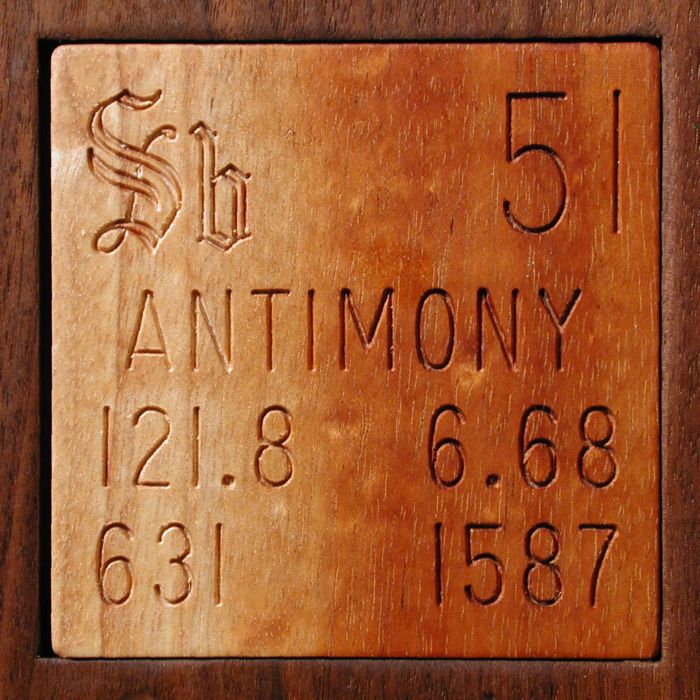
Antique brooch pin.
Antimony is a major component of pewter, which is popular for making this sort of item out of. So it's perhaps not too farfetched that someone would make a pin like this out of plain antimony, though the only evidence for this is the unsubstantiated claim of the eBay seller. But why would he lie?
Next time I have some samples analyzed I'll take this one along and then we'll know for sure.
Source: eBay seller jnqmn
Contributor: Theodore Gray
Date Acquired: 18 July, 2002
Price: $5
Size: 3"
Purity: >80%
Crystals.
This is pure crystalline antimony.
Source: Mark Rollog
Contributor: Mark Rollog
Date Acquired: 20 July, 2002
Price: Donated
Size: 0.3"
Purity: >99%
Foo Lion incense burner.
Another item claimed to be made of antimony. No verification, but no reason to doubt it either. Kind of cute.
Source: eBay seller rmoy
Contributor: Theodore Gray
Date Acquired: 25 July, 2002
Price: $5
Size: 3"
Purity: >80%
Antique Jelly Jar.
Yet another item claimed to be made of antimony. I'm using this one for donations to support the apple bowl outside my office.
Source: eBay seller maurineandken
Contributor: Theodore Gray
Date Acquired: 25 July, 2002
Price: $30
Size: 4"
Purity: >80%
Hand Painted Miniature Antimony Models.
I guess including the element name on the packaging is no stranger than calling old metal toys "tin toys" or "cast iron banks". Somehow it just seems that way in this case.
Source: eBay seller handmedownz
Contributor: Theodore Gray
Date Acquired: 9 August, 2002
Price: $5
Size: 4"
Purity: >80%

Group:
Transition Metals
Collections:
Elements with Sounds
www.webelements.com
chemicalelements.com
Los Alamos
Royal Society
Environmental Chemistry
Phoenix College
Minerals
X-Ray Properties
Science Fiction Science Fiction Main
Comics
Poetry Poetry Main
Coiled filament wire.
Kindly donated by David Franco,who sent many elements after seeing the slashdot discussion.
Source: David Franco
Contributor: David Franco
Date Acquired: 17 May, 2002
Price: Donated
Size: 0.04"
Purity: >99%
Small rectangle of 0.1mm foil, 99.99%
This small sample was kindly donated by George (not 007) Lazenby, who saw the slashdot discussion. It came in a lovely little plastic vial.
George got this and the other samples he donated at a surplus auction of his highschool. It seems he was the only one there who appreciated the erbium foil. This sample and the others he sent had been donated to the school by a former student who worked at NIST (National Institute for Standards and Testing), where they had been used as x-ray calibration standards. This means they are probably very pure.
Source: George (not 007) Lazenby
Contributor: George (not 007) Lazenby
Date Acquired: 24 May, 2002
Price: Donated
Size: 1"
Purity: 99.99%
Large rectangle of heavy foil.
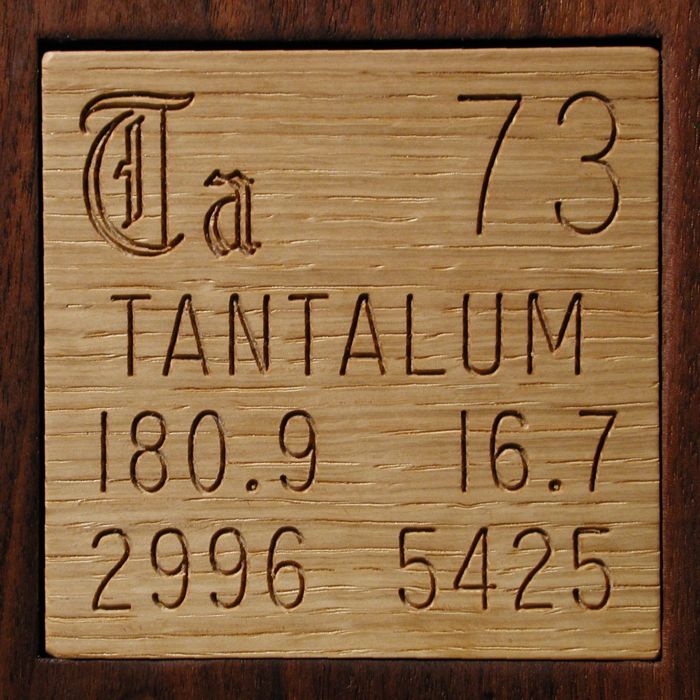
This fabulous, quite valuable sample of tantalum was most graciously donated by .George (not 007) Lazenby, who saw the slashdot discussion. I don't know the exact thickness, but it's quite stiff and solid for a foil. It didn't quite fit under the tile, so I trimmed it square and carved an area over the sample hole so it could serve as a sub-lid underneath the wooden lid.
George got this and the other samples he donated at a surplus auction of his highschool. It seems he was the only one there who appreciated the erbium foil. This sample and the others he sent had been donated to the school by a former student who worked at NIST (National Institute for Standards and Testing), where they had been used as x-ray calibration standards. This means they are probably very pure.
Source: George (not 007) Lazenby
Contributor: George (not 007) Lazenby
Date Acquired: 9 June, 2002
Price: Donated
Size: 3.5"
Purity: >99.9%
Length of rod, bent.
This is a short length of rod, about 2 inches long and 5/16 inch diameter, obviously nipped off at both ends with some bolt butters or a sheer. It's fairly heavy, but not otherwise impressive compared to the same thing out of steel.
Source: Neil Lipson
Contributor: Theodore Gray
Date Acquired: 12 July, 2002
Price: $10
Size: 2"
Purity: >95%
Electrodes.
I got these tantalum electrodes on eBay. How do I know they are really tantalum? Because I trust in the basic goodness of the eBay community and have no doubt that every item is exactly what it's claimed to be, especially the elements.
Source: eBay seller snooj
Contributor: Theodore Gray
Date Acquired: 22 August, 2002
Price: $10
Size: 0.2"
Purity: >90%

Group:
Non-Metals
Collections:
Elements with Sounds
Elements with Videos
Fun/Dangerous Experiments
Elements at Walmart
Elements in the Human Body
www.webelements.com
chemicalelements.com
Los Alamos
Royal Society
Environmental Chemistry
Phoenix College
Minerals
X-Ray Properties
Science Fiction Science Fiction Main
Comics
Poetry Poetry Main
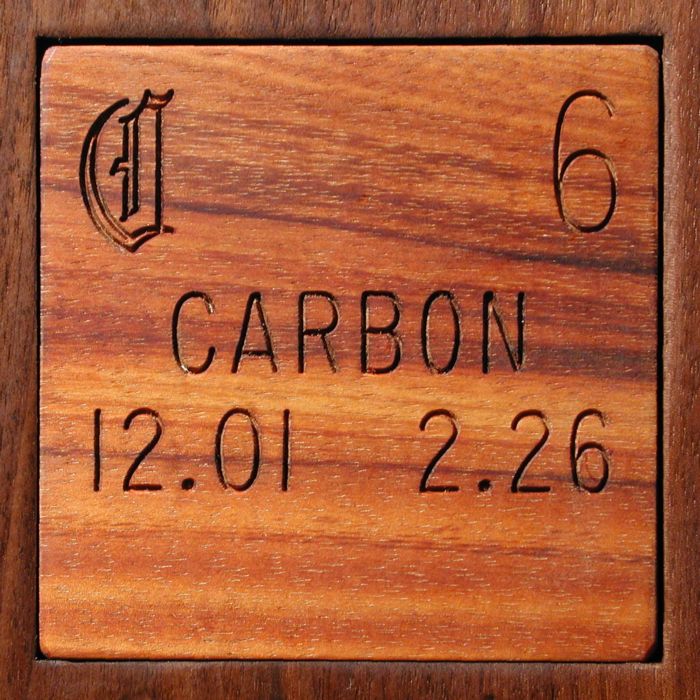
Anthracite coal.
I purchased about 1000 pounds in the early 1990s for blacksmithing use by Jim Zimmerman at our farm. We had to build a special box on the trailer to bring it home, and most of it is still sitting in large plastic containers in the shed. No problem finding a sample for the table!
The sound is steel plate being beaten with a blacksmith's hammer after heating in a coal fire.
Source: Coal Dealer
Contributor: Theodore Gray
Date Acquired: 15 April, 2002
Price: $0.008/ounce ($250/ton)
Size: 2"
Purity: >85%
Graphite rod from lantern battery.
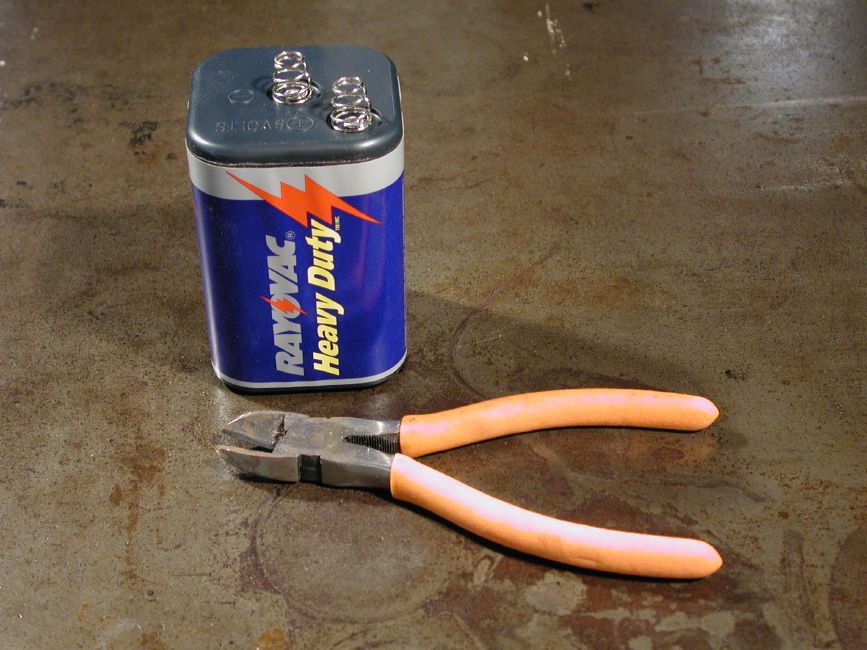
I took apart one of those big lantern batteries probably some time in the late 1970s because I needed a graphite rod for stirring molten metals. Graphite is good because metal doesn't stick to it, it doesn't contaminate the metal, and it retards oxidation to some extent.
In order to show you how it's done, I took apart another one in the summer of 2002 and photographed the process. You start with an ordinary (not alkaline) lantern battery (6V will give you 4 electrodes, 12V will give you 8), and a pair of diagonal cutters (or whatever tool you have handy):


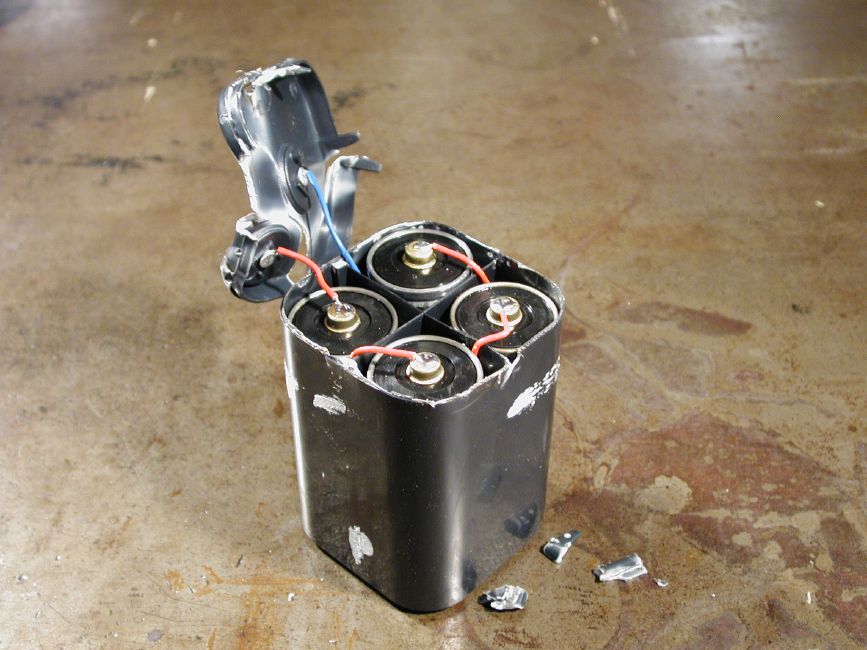
It makes no difference if the battery is new or all run down, the graphite is not effected by the discharging of the battery. First cut off the spring terminals (to reduce the chance of short circuits) and peal off any labels so you can see what you're dealing with:


Every brand is no double a little different, but all of them will contain four (or eight) individual metal cans. The plastic case around them is just to hold them in place, and you can break it open any way you like:


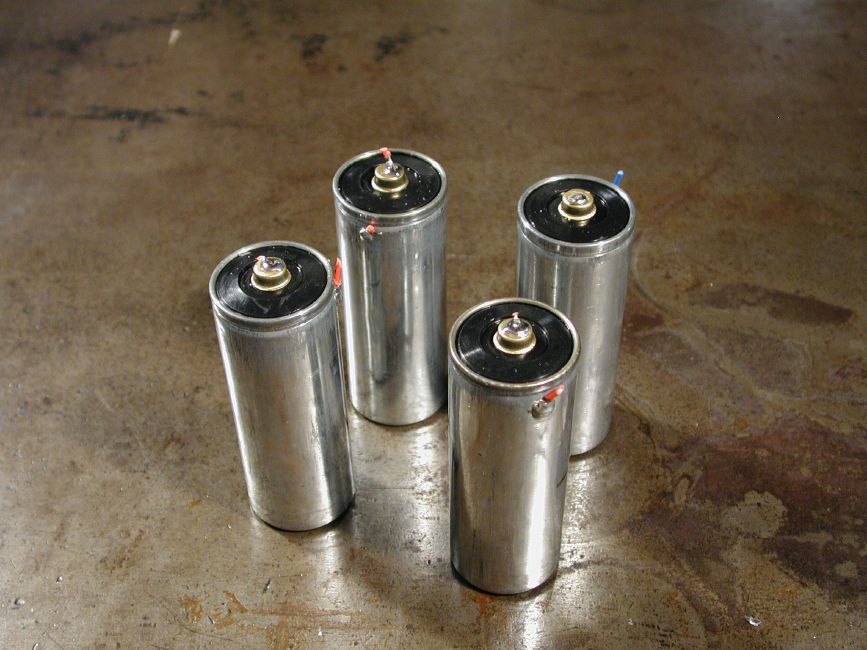
And take out the individual (1.5V zinc-carbon) cells:

(A clever and foresightful person would not clip the wires off like I did, but rather leave them and the metal caps on as a convenient way to make connections to the electrodes.)

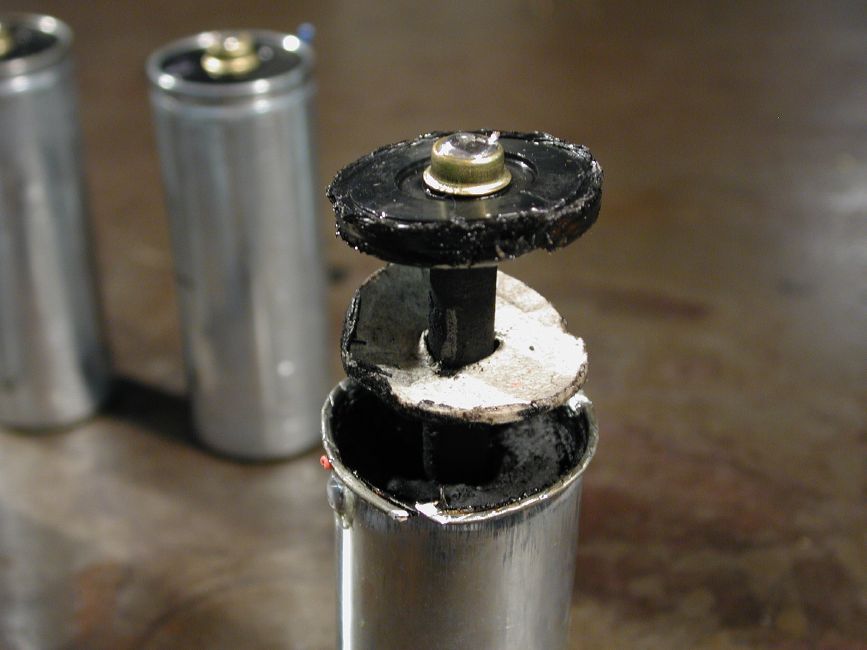
Use the diagonal cutters to open up the crimped rim around the top, freeing the disk that closes the top, then pull it and the electrode up and out of the goop:


Some brands may be harder to do than the one I had, but in my case the electrode pulled out easily and cleanly, and could easily be separated from the disk. I pushed the disk back down into the can to form a convenient container for disposal. The goop is of no interest here. Clean the electrodes off with paper towel and sandpaper to get a nice clean graphite surface:


Even if you buy a brand new battery, you're paying about one dollar per rod, which is cheap compared to buying graphite rods from a chemical or foundry supply company. They're probably not very pure, but they work great for things like isolating hydrogen or stirring molten metal.

Source: Hardware Store
Contributor: Theodore Gray
Date Acquired: 15 April, 2002
Price: $5/battery with 4 of them
Size: 3"
Purity: >95%
Pyrolytic graphite.
Ed reports: The source (and inspiration) was
http://www.scitoys.com/scitoys/scitoys/magnets/pyrolytic_graphite.html
The details for making it are on the site. The main point of these samples is that they have the highest Hall effect of any material (the degree to which it will repel a magnet). The Hall effect is strong enough that a piece of pyrolytic graphite will levitate over neodymium magnets, as you can see in the video.
Source:
Science Toys
Contributor: Ed Pegg Jr
Date Acquired: 15 April, 2002
Price: $2
Size: 1"
Purity: >99%
Gem cut cubic zirconium just to fool people.
So far, no one has been fooled, probably because it's too big to be believable (10mm round brilliant cut CZ from http://www.pehnec.com). But it is very beautiful!
Source: Pehnec Gems
Contributor: Theodore Gray
Date Acquired: 17 April, 2002
Price: $60/50 stones
Size: 0.39"
Purity: <50%

Group:
Alkali Earth Metals
Collections:
Elements with Sounds
Fun/Dangerous Experiments
Elements at Walmart
Elements in the Human Body
www.webelements.com
chemicalelements.com
Los Alamos
Royal Society
Environmental Chemistry
Phoenix College
Minerals
X-Ray Properties
Science Fiction Science Fiction Main
Comics
Poetry Poetry Main
Camp fire starter.
Commonly used fire starter: You carve off some shavings of Magnesium from the block using your hunting knife, then strike the flint with the back of the knife to ignite the shavings. I removed the striker bar (see Cerium for a video of this bar being sparked with a knife). This one was purchased from Walmart in April 2002.
Source: Walmart
Contributor: Theodore Gray
Date Acquired: 15 April, 2002
Price: $4
Size: 3"
Purity: >95%
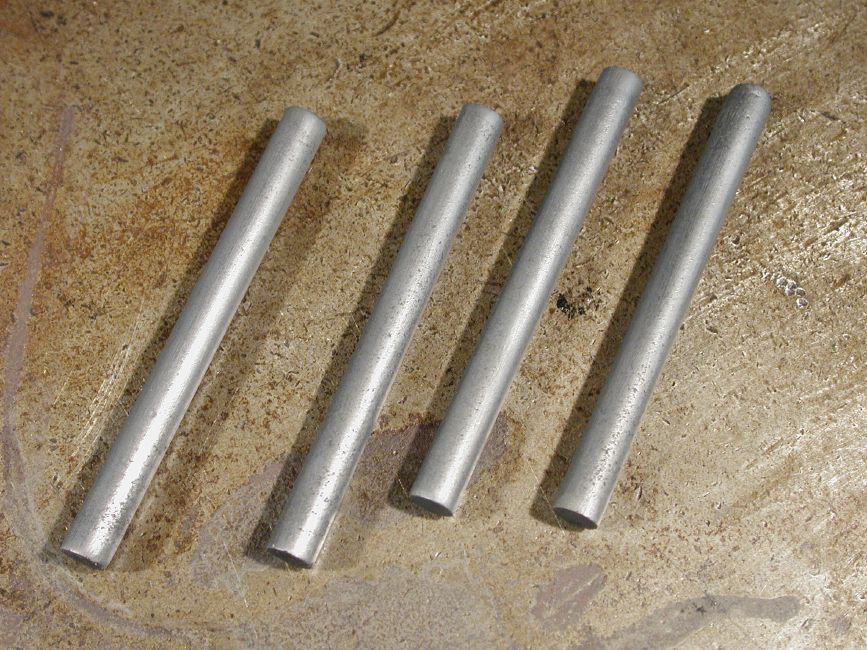
Bulk rod.
Bulk magnesium metal rod, about 1.25" diameter. No idea where it's from or what it was used for, but it burns nicely in shaving form. This one was purchased from eBay in May 2002.
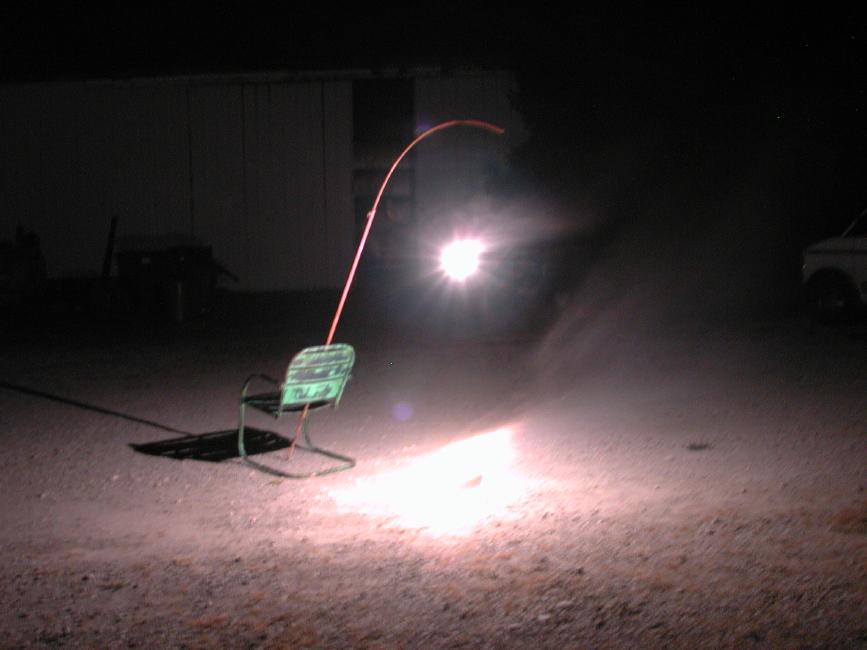
Ed Pegg and I spent an entertaining evening burning about 6 inches of one of these bars in two three inch sections.
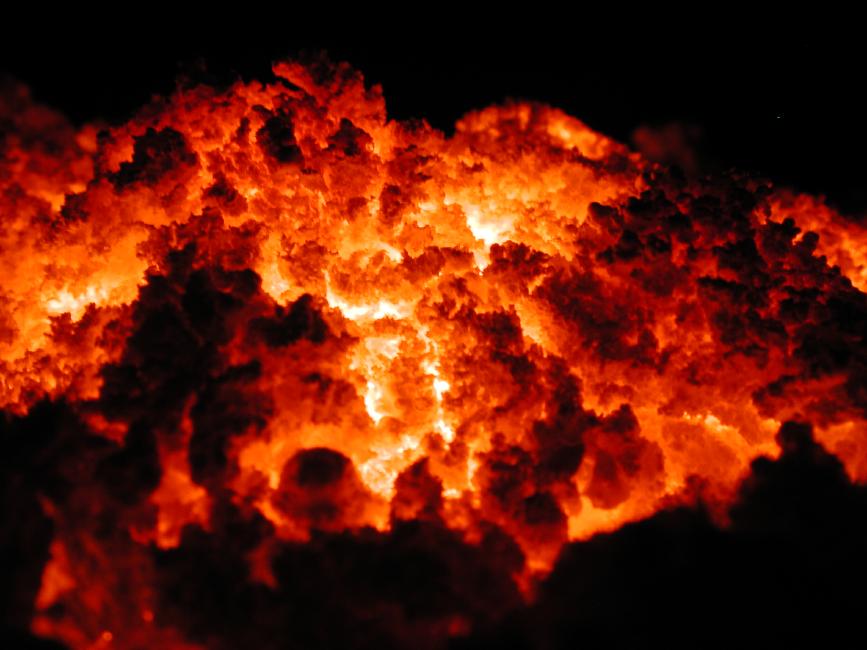
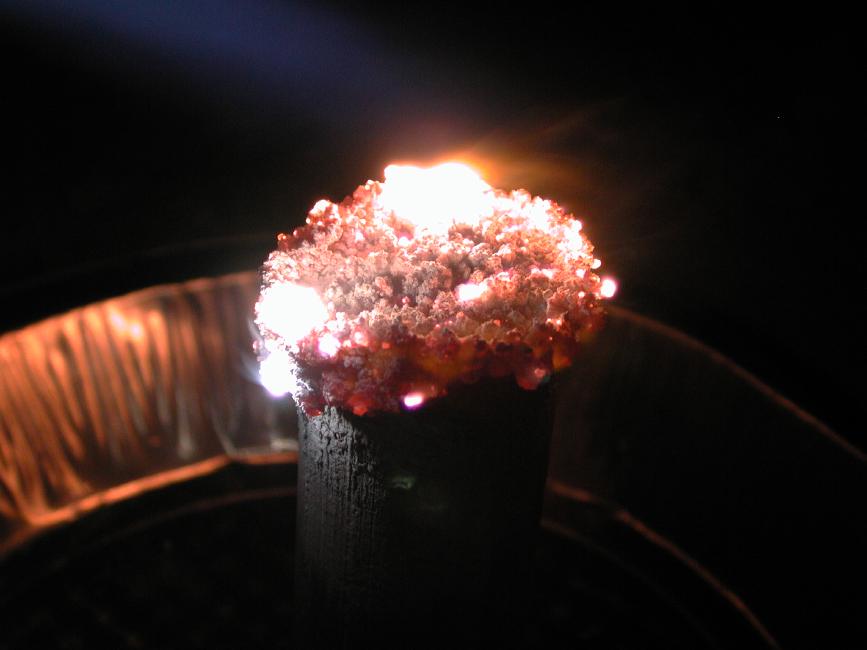
The first thing to say about bulk magnesium is that it's really hard to light. We hung the first bar from a wire out in my gravel lot, and pointed a propane torch at it. I had used a chisel to turn up a few corners, because I though they would light more easily than the bulk metal. They did, but then went out as soon as the flame reached the bulk of the cylinder. I literally had to hold the torch to the cylinder for 15 minutes or more until it finally started burning for real. The whole thing must have been heated to near the ignition temperature before anything happened. Here's picture of Ed and the rod when it first started burning:


Once it started, it did burn nicely, and lit up a good area:


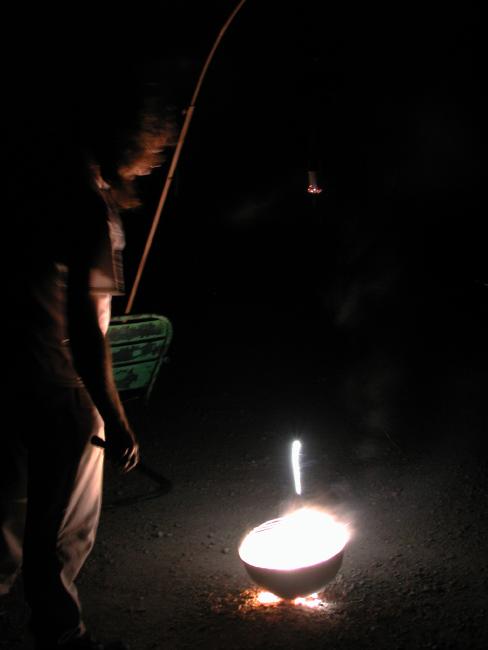
It dropped marvelous flaming balls of molten magnesium to the ground below:


Those flaming balls continued to burn and created fabulous volcanic formations:


Next we tried burning one from the top down, to see if it did anything differently. It was more or less the some, though it did form a nice mushroom head when it first lit (after another 15 minutes of propane):


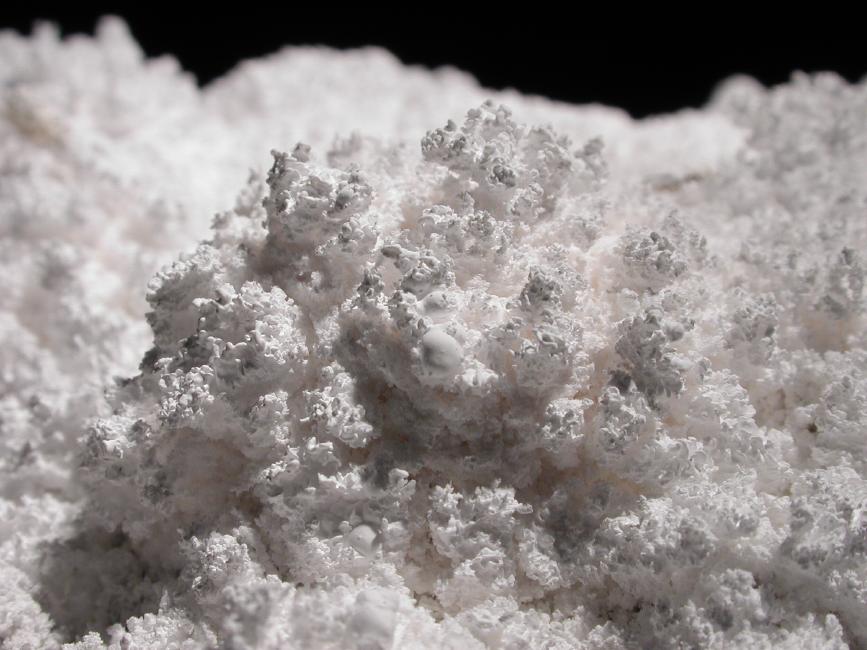
The end product of it all was a pile of blindingly white magnesium oxide crystals, which crumbled away by morning:


Source: eBay seller magman1000
Contributor: Theodore Gray
Date Acquired: 29 May, 2002
Price: $6/pound
Size: 1.25"
Purity: >95%

Group:
Metalloids
Collections:
Elements I Need Samples Of
www.webelements.com
chemicalelements.com
Los Alamos
Royal Society
Environmental Chemistry
Phoenix College
Minerals
X-Ray Properties
Science Fiction Science Fiction Main
Comics
Poetry Poetry Main
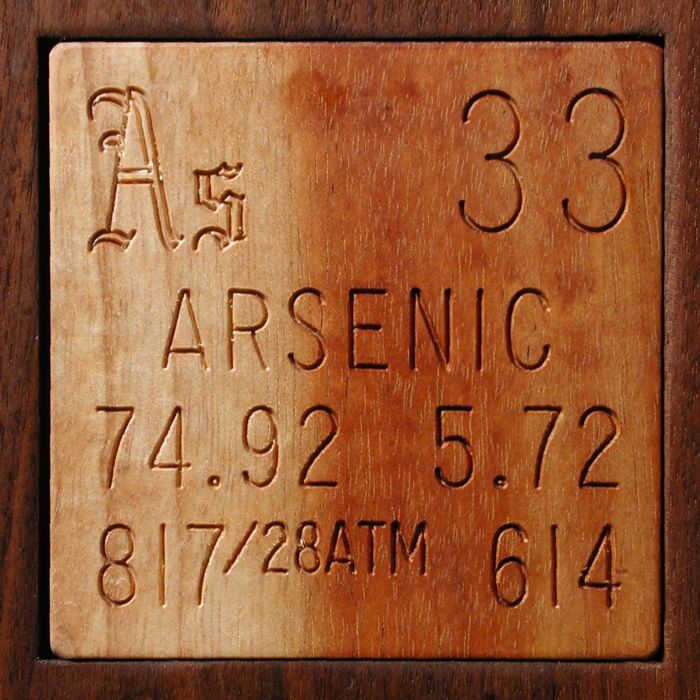
CCA treated wood.
CCA (chromated copper arsenate) treated wood is nasty, nasty stuff.

Arsenic is very toxic. It is an acute poison, a contact poison, a chronic cumulative poison, and a carcinogen. There is no part of arsenic that is not poisonous. This sample of treated lumber would make you very sick if you ate it. A treated lumber deck has enough arsenic to kill at least a hundred people, including you. Do not use acidic deck washes. Never, never burn treated lumber.

And shop at Menards: They have eliminated arsenic from their treated lumber two years before it is due to be banned.

Source: Hardware Store
Contributor: Theodore Gray
Date Acquired: 15 April, 2002
Price: Donated
Size: 3"
Purity: <5%

Group:
Transition Metals
Collections:
Favorite Samples
Elements with Sounds
Elements with Videos
www.webelements.com
chemicalelements.com
Los Alamos
Royal Society
Environmental Chemistry
Phoenix College
Minerals
X-Ray Properties
Science Fiction Science Fiction Main
Comics
Poetry Poetry Main
Small lump 99.6%.
Kindly donated by David Franco, who sent many elements after seeing the slashdot discussion.
Source: David Franco
Contributor: David Franco
Date Acquired: 17 May, 2002
Price: Donated
Size: 0.2"
Purity: 99.6%
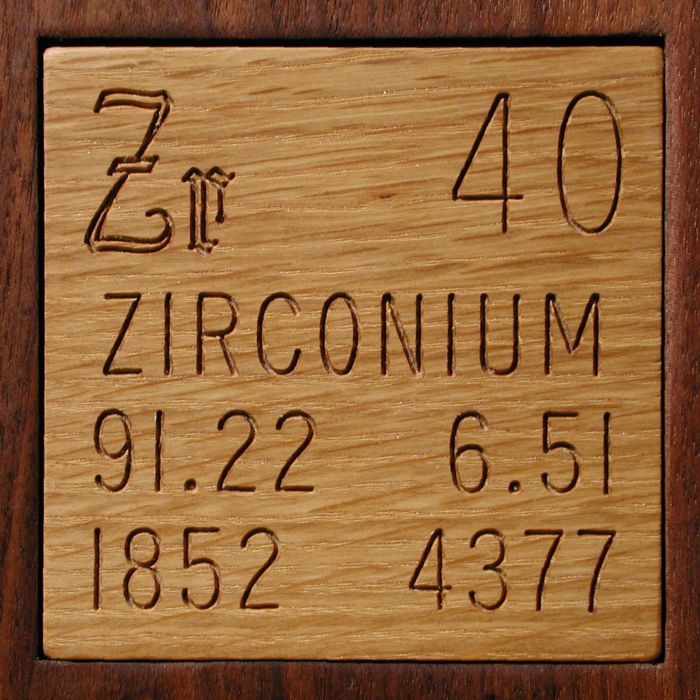
Gem cut Zirconium oxide (cubic).
These beautiful 10mm brilliant cut CZ were purchased from http://www.pehnec.com in April 2002. Everyone who sees them agrees they are spectacular, especially when you consider the same size diamond would cost 10,000 times more and not look much better, if any.
Source: Pehnec Gems
Contributor: Theodore Gray
Date Acquired: 17 April, 2002
Price: $60/50 stones
Size: 0.39"
Purity: <50%
Slice of Historical Sample.
We are very honored to have received a slice cut from one of the first batches of pure zirconium metal ever to have been isolated. Randall Fullman donated this sample, and has this story about it:

"My grandfather, Martin Farlee, was an engineer who worked on the process to refine this metal at the US Bureau of Mines, Albany Research Center. Due to the flammable nature of the metal and the need for high purity for the nuclear industry, the process developed involved refining it in a vacuum using induction heating. I wished I could have gotten photos of the crucibles and induction equipment. In the same chamber in which it was refined, it was poured to make ingots for the tests. This sample is from these tests."
"As an industrial metal, it is not traded as a precious metal such as gold, silver, platinum, etc. However about 30 years ago it was more valuable than platinum. "
"The metal properties that are of interest are it's high strength, and the fact that it is transparent to radiation. The main use for the metal is in fuel rods in nuclear reactors. It holds the fuel pellets while not interfering with the reaction by absorbing radiation."
"Due to the use of the metal in the nuclear industries, the refining process came under the gun of the nuclear regulatory commission. Even though the metal is not radioactive, it is refined from sand from Australia. A survey of the tailings of the sand found a background radiation level very much like the level found in most red bricks used in buildings. As such it was declared low level radioactive waste, just the same as many old government buildings. This has created much grief for WaChang (a major refiner of zirconium), just as it has for many demolition companies trying to dispose of old bricks."

On the subject of why he's willing to send us a piece of this sample, Randall reports:
"Due to the shape of the sample, and the fact I had used it to pound nails in a pinch, taking a small slab off the bottom is not a problem. As promised, I got a sample cut for you after I found someone with a saw with liquid cooling."
Source: Randall Fullman
Contributor: Randall Fullman
Date Acquired: 26 June, 2002
Price: Donated
Size: 3"
Purity: >99.5%
Fake Emerald.
This is a fake (cubic zirconium based) emerald from http://www.pehnec.com. We once thought the color was from yttrium, but now I doubt that, so it's been moved under zirconium because that's the one thing I do believe about it.
Source: Pehnec Gems
Contributor: Ed Pegg Jr
Date Acquired: 15 July, 2002
Price: $10
Size: 0.4"
Purity: <50%
Tiny cylinder.
Ed bought half a dozen different tiny metal cylinders from David Franco, intending to make some kind of puzzle out of them (Ed's a puzzle person). But they turned out to be too irregular, so he donated them to the table.
Source: David Franco
Contributor: Ed Pegg Jr
Date Acquired: 19 August, 2002
Price: Donated
Size: 0.2"
Purity: 99.6%

Group:
Other Metals
Collections:
Elements with Sounds
Fun/Dangerous Experiments
Elements at Walmart
Elements in the Human Body
www.webelements.com
chemicalelements.com
Los Alamos
Royal Society
Environmental Chemistry
Phoenix College
Minerals
X-Ray Properties
Science Fiction Science Fiction Main
Comics
Poetry Poetry Main
Lead-free fishing weights.
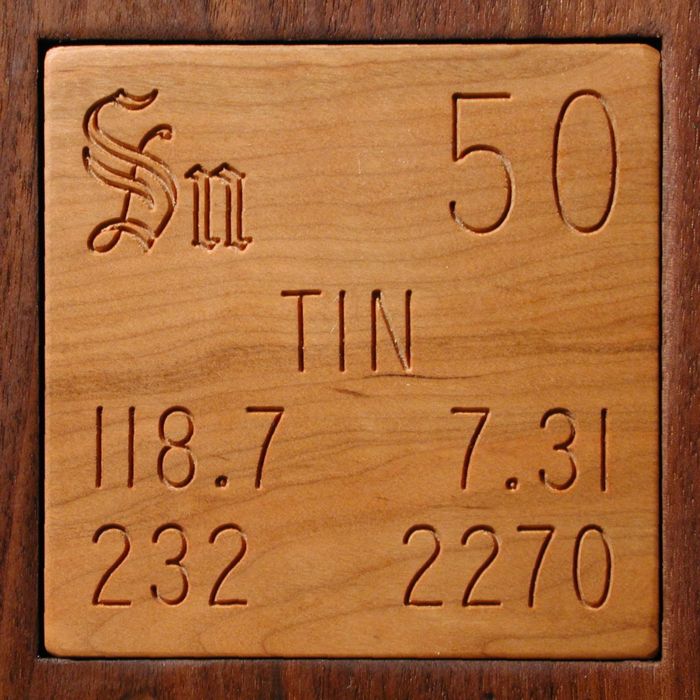
Melted down and allowed to cool in the standard graphite crucible used for several metal samples. Environmental concerns have prompted a switch from lead to tin for fishing sinkers.Purchased at Walmart in April 2002. Source originally suggested by Ed Pegg.
Source: Walmart
Contributor: Theodore Gray
Date Acquired: 24 April, 2002
Price: $14/10 bags of weights
Size: 1.25"
Purity: >95%
Crying bars.
The "Tin Cry" is an oft-described, seldom-heard phenomenon. If, it is claimed, you bend a bar of tin, it will "cry" as the crystal structure is disrupted. When NPR's Science Friday program asked to interview me about the Periodic Table Table, I decided it was time for the world to hear the tin cry live on the radio.
I had to make these bars in a hurry, before the kids woke up in the morning and needed to be fed, so I just poured out some silica sand and drew a line in it with my finger, then poured the molten tin into the groove, forming these crude bars. Then I bent them by hand and using a pair of pliers while holding them up to a microphone connected to a laptop.
I'll let you be the judge of whether they "cry" or not: Personally I'd call it more of a crackle-crackle-crackle sound. In any case, click the speaker icon to hear it (the bent up bar at top of the picture is the one that made this sound). I would certainly be curious to hear from anyone who has created a better crying sound from tin.
Source: Walmart
Contributor: Theodore Gray
Date Acquired: 16 July, 2002
Price: $14/10 bags of weights
Size: 3"
Purity: >95%

Group:
Halogens
Collections:
Elements in the Human Body
www.webelements.com
chemicalelements.com
Los Alamos
Royal Society
Environmental Chemistry
Phoenix College
Minerals
X-Ray Properties
Science Fiction Science Fiction Main
Comics
Poetry Poetry Main
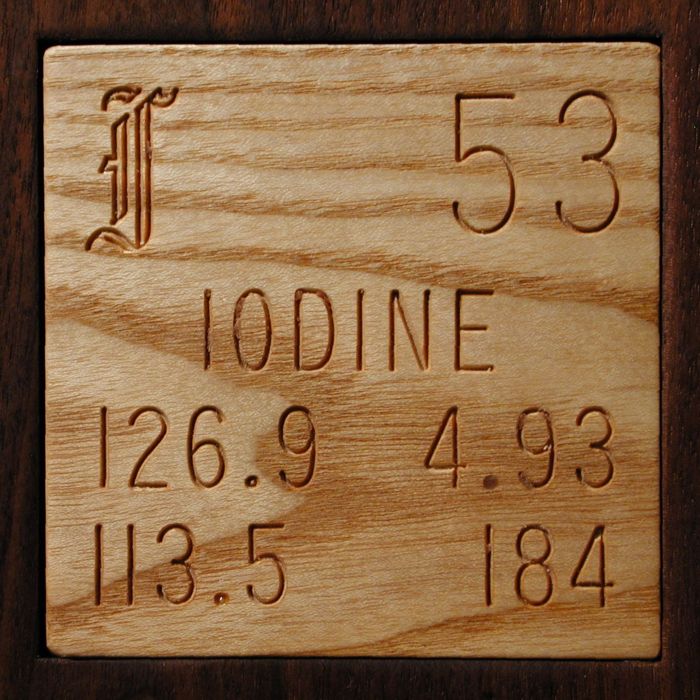
Tincture of Iodine (I and NaI in water/alcohol mixture).
Kindly contributed by Ed Pegg.
Source: Walgreens Pharmacy
Contributor: Ed Pegg Jr
Date Acquired: 20 May, 2002
Price: $5
Size: 3"
Purity: <5%
Small crystals, 99.99%.
Kindly donated by David Franco, who sent many elements after seeing the slashdot discussion, and this one after I sent him some Mathematica t-shirts.
Source: David Franco
Contributor: David Franco
Date Acquired: 11 June, 2002
Price: Donated
Size: 0.05"
Purity: 99.99%

Group:
Rare Earth Metals
Collections:
Elements with Sounds
Elements with Videos
Elements I Need Samples Of
www.webelements.com
chemicalelements.com
Los Alamos
Royal Society
Environmental Chemistry
Phoenix College
Minerals
X-Ray Properties
Science Fiction Science Fiction Main
Comics
Poetry Poetry Main
Mischmetal striking flint.
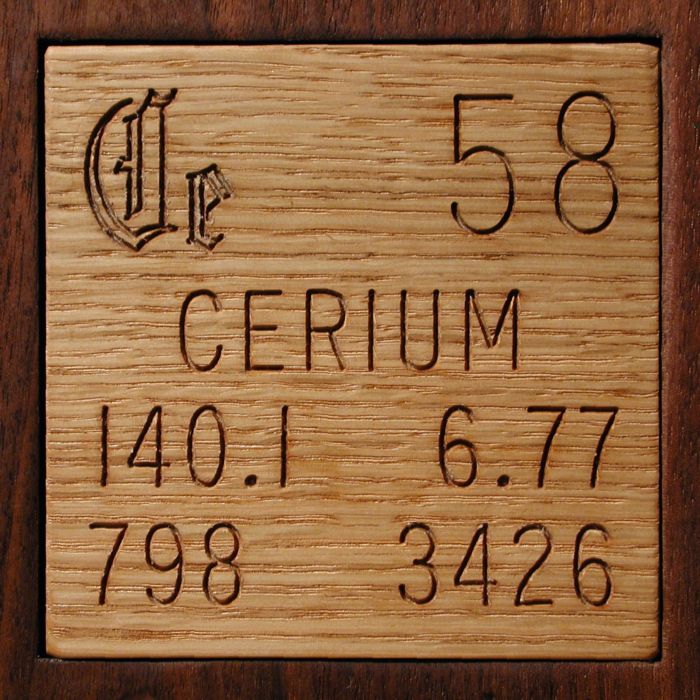
Removed from the camp fire starter that supplied the Magnesium sample, purchased at Walmart in April 2002. Probably about 20-30% Cerium overall, the remainder being other rare earths and iron.
Source: Walmart
Contributor: Theodore Gray
Date Acquired: 15 April, 2002
Price: $4
Size: 3"
Purity: <30%

Group:
Transition Metals
Collections:
Elements in Spark Plugs
www.webelements.com
chemicalelements.com
Los Alamos
Royal Society
Environmental Chemistry
Phoenix College
Minerals
X-Ray Properties
Science Fiction Science Fiction Main
Comics
Poetry Poetry Main
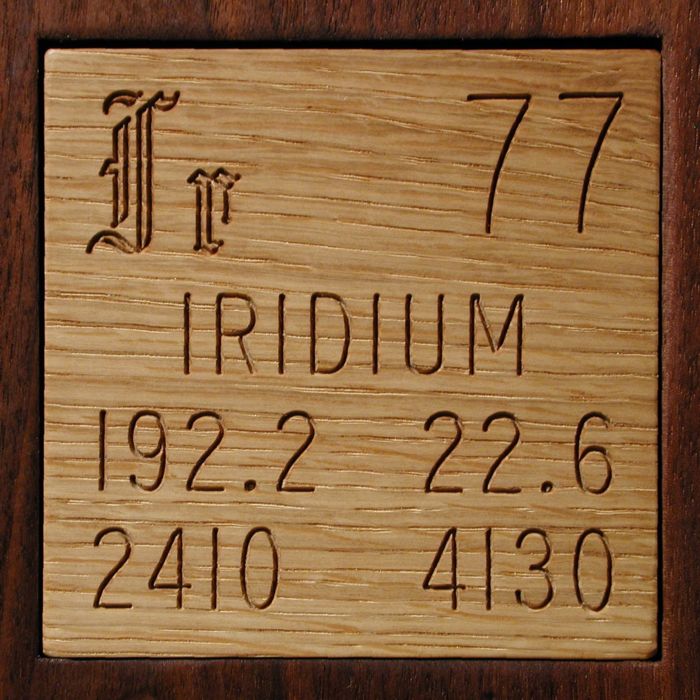
Spark Plug.
People make spark plugs out of the craziest elements, like Polonium. Iridium probably makes a certain amount of sense, because it's likely to survive a long time under harsh conditions. Whether it's much advantage over platinum I wouldn't know.
Source: eBay seller accurateimage@yahoo.com
Contributor: Theodore Gray
Date Acquired: 31 July, 2002
Price: $18
Size: 3"
Purity: >90%

Group:
Transition Metals
Collections:
Elements with Sounds
Elements at Walmart
Elements in Spark Plugs
www.webelements.com
chemicalelements.com
Los Alamos
Royal Society
Environmental Chemistry
Phoenix College
Minerals
X-Ray Properties
Science Fiction Science Fiction Main
Comics
Poetry Poetry Main
One ounce bullion bar.
I purchased this bar for spurious reasons in the early 1990s from a coin dealer near Berkeley, California. I think I paid about $500 for it, and now it's worth about $550, but in the meantime it's been worth more than double that, because of the price spike caused by catalytic converters in cars. I never noticed between then and now how much the price had gone up and back down.
In April 2002 I had Brian Knox jewelers in Champaign, Illinois weld a 90%Pt/10%Ir alloy loop onto the back of it, so it could be locked down to the table with a length of stainless steel cable.
Source: Coin Shop in California
Contributor: Theodore Gray
Date Acquired: 15 April, 2002
Price: $600/including loop
Size: 1.5"
Purity: 99.95%
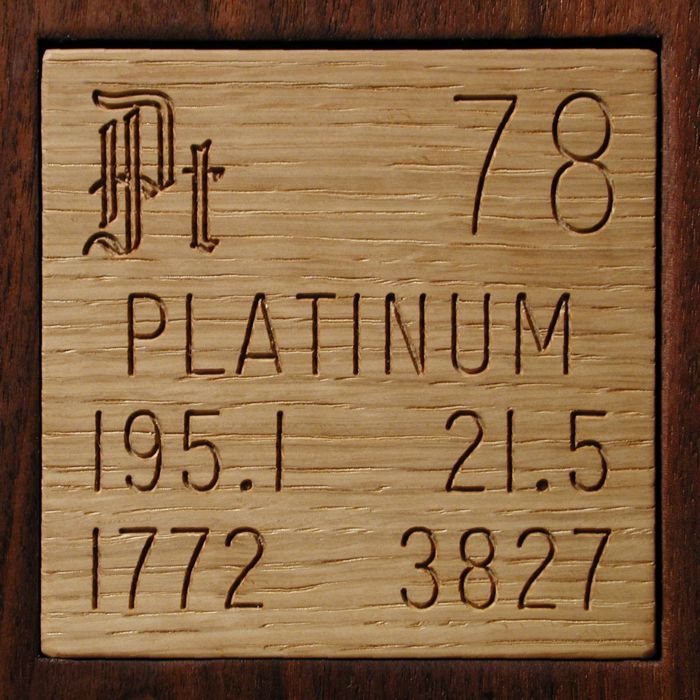
Spark Plug.
People make spark plugs out of the craziest elements, like Polonium. Platinum is used because it doesn't corrode under harsh conditions.
I remember hearing, probably on NPR's Car Talk show, that platinum spark plugs last so long that by the time you need to change them, they may have fused themselves to the aluminum block they are screwed into, making it impossible to remove them without stripping the engine block. They recommended just unscrewing and rescrewing them every couple of years. Ah, such modern problems.
Source: eBay seller accurateimage@yahoo.com
Contributor: Theodore Gray
Date Acquired: 31 July, 2002
Price: $15
Size: 3"
Purity: >90%

Group:
Transition Metals
Collections:
Elements with Sounds
Elements at Walmart
www.webelements.com
chemicalelements.com
Los Alamos
Royal Society
Environmental Chemistry
Phoenix College
Minerals
X-Ray Properties
Science Fiction Science Fiction Main
Comics
Poetry Poetry Main
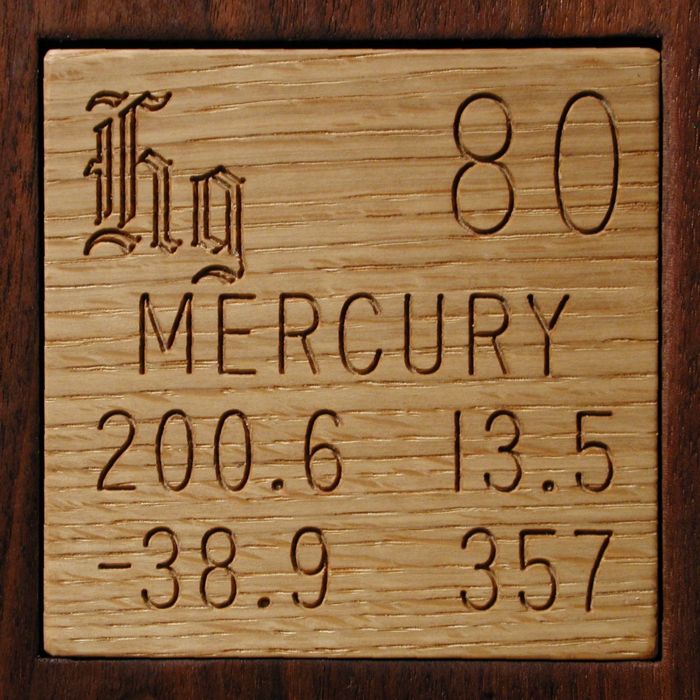
Tilt switch from old thermostat.
I replaced an old thermostat at our square house in Urbana, Illinois in late 2001, and this is the tilt switch from it. It had probably been there for decades. A thermostat works by mounting this kind of tilt switch on a coiled bi-metallic strip, which coils and uncoils slightly as the temperature changes. When the switch tilts out of level the mercury flows to one side or the other, turning on the heat or air-conditioning depending on the direction of tilt. The weight of the mercury tips the balance slightly further in the direction it went, providing a built-in hysteresis effect.
Source: Hardware Store
Contributor: Theodore Gray
Date Acquired: 15 April, 2002
Price: $10/new thermostat
Size: 1"
Purity: >95%
Vial of antique mercury.
This small glass vial came from Rob Raguet-Schofield's wife's coworker's parents who had it in their basement and didn't know what to do with it. They thought about burying it in the back yard but I took it off their hands instead.
You have got to listen to the sound of this sample.
Source: Rob Raguet-Schofield
Contributor: Rob Raguet-Schofield
Date Acquired: 22 May, 2002
Price: Donated
Size: 3"
Purity: >95%

Group:
Metalloids
Collections:
Radioactive Elements
Elements in Spark Plugs
Elements I Need Samples Of
www.webelements.com
chemicalelements.com
Los Alamos
Royal Society
Environmental Chemistry
Phoenix College
Minerals
X-Ray Properties
Science Fiction Science Fiction Main
Comics
Poetry Poetry Main
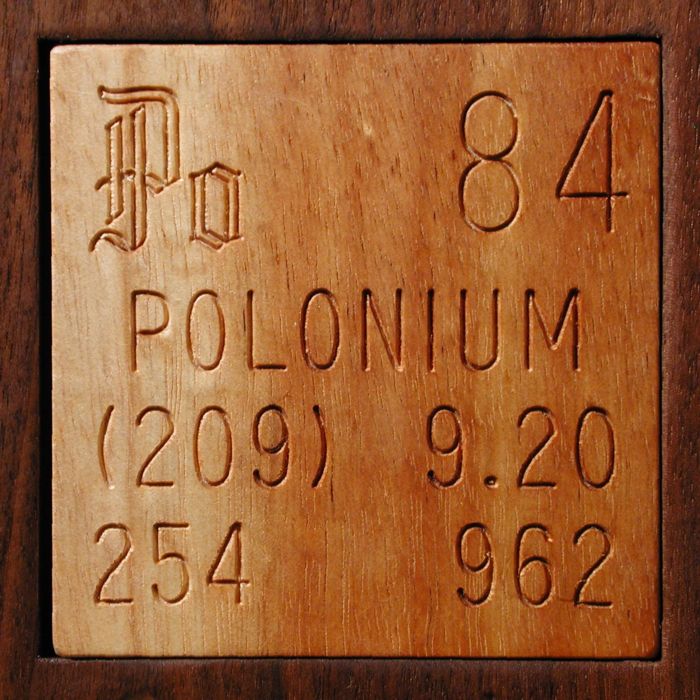
Radioactive Sparkplugs.
For some crazy reason, in the 1950's Firestone made automotive sparkplugs containing radioactive polonium. Presumably the idea was that the ionizing radiation would allow the spark to travel more easily, making for better ignition. I think it's a fairly far-fetched idea.
According to the information I have found on these plugs, they probably contain(ed) Polonium-210, with a half-life of only 138 days. Whatever radioactivity there was in 1950 is long gone now! Though, my geiger counter does reveal a very slight increase over background, maybe 300cpm, around the ceramic portion of the plug, none around the electrode tip. My guess is there is some totally unrelated radioactive contamination in the ceramic material or the glaze.
Amusingly, the Geiger counter I used to test them is a very nice one I got (for $40) at the closing out auction of a local Bridgestone/Firestone tire plant (it's the one that made the tires that practically put Firestone out of business in 2001). So I'm using equipment from a failed Firestone plant to test a failed Firestone product from 50 years ago!
This, incidentally, is the 100th sample installed in the table.
Source: eBay seller glenben1
Contributor: Theodore Gray
Date Acquired: 17 July, 2002
Price: $31
Size: 3"
Purity: 0%
Antistatic brush.
These brushes, which you can still buy today (2002) are made for brushing static charge off of photographic negatives. The radiation from the polonium element (which must be replaced every year or so because the half life is only 138 days) ionizes the air around the brush, making it conductive and carrying away the static charge.
This particular brush has an interesting history. Today (the date given below) I spent the afternoon at an old abandoned hospital complex tearing lead sheeting out of the former x-ray room (with, of course, the full permission of the owner, a developer who is going to demolish the building shortly). Ed Pegg, Jim, and I mined about 3/4 of a ton of lead in two and a half hours. It was hot, so we had to take breaks which consisted of wandering around this very large and quite eerie complex, bumping into things like stacks of old medical records and sharps containers with their contents of syringes and needles spilled out on the floor.
Near the CAT scan machine, which was still there, this brush was just lying on the table. I'd been intending to buy a new one exactly like it when I got around to it, but this is much better. Except for the fact that, as you can see in the picture, it is due to be replaced in 1984, and therefore has essentially no actual polonium left in it. That's the problem with these silly radioactives: They just keep evaporating on you.
Source: Theodore Gray
Contributor: Theodore Gray
Date Acquired: 31 July, 2002
Price: Donated
Size: 1"
Purity: 0%

Group:
Alkali Earth Metals
Collections:
Favorite Samples
Radioactive Elements
Elements I Need Samples Of
www.webelements.com
chemicalelements.com
Los Alamos
Royal Society
Environmental Chemistry
Phoenix College
Minerals
X-Ray Properties
Science Fiction Science Fiction Main
Comics
Poetry Poetry Main
Oil pressure gauge luminous dial.
This oil pressure gauge is out of a WWII bomber and it has a luminous dial made with radium paint. The luminosity seems to have faded, as expected given the half-life of radium, but it's still definitely radioactive as measured by a Geiger counter. It was donated by Trish Craig of the Environmental Health & Safety department at the University of Illinois at Urbana-Champaign.
Source: Trish Craig
Contributor: Trish Craig
Date Acquired: 28 May, 2002
Price: Donated
Size: 3"
Purity: <1%

Group:
Alkali Metals
Collections:
Elements with Videos
Fun/Dangerous Experiments
Elements in the Human Body
www.webelements.com
chemicalelements.com
Los Alamos
Royal Society
Environmental Chemistry
Phoenix College
Minerals
X-Ray Properties
Science Fiction Science Fiction Main
Comics
Poetry Poetry Main
Bottle of Homemade hydrogen.
This is a very Martha Stewart sample: I made it from scratch with two batteries, two paper clips, and a cup of salt water. (Sorry Martha, I did not use flavored sea-salt.)

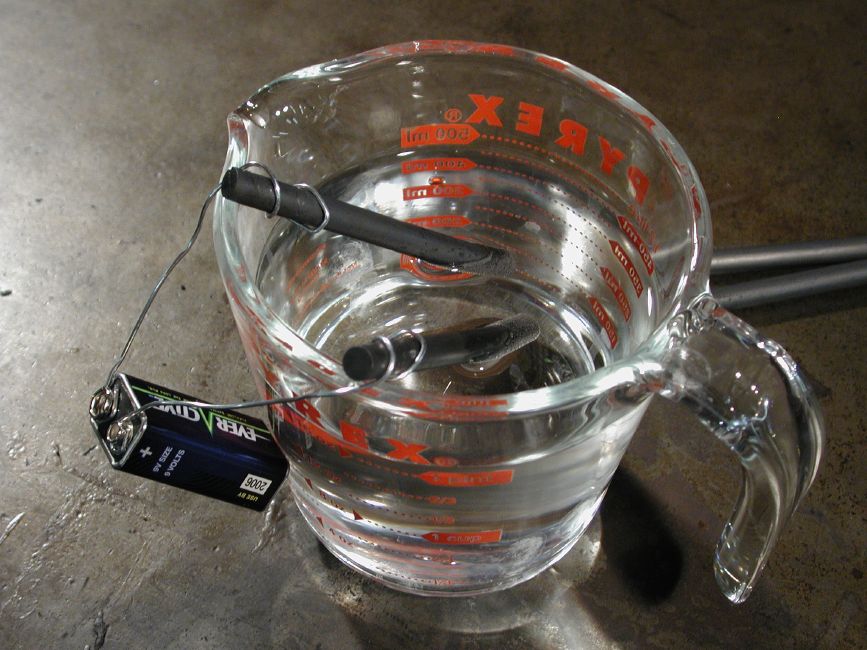
Making hydrogen gas is actually extremely easy. I first did it when I was probably 15, and it's really hard to fail. Connect two wires to a 9V battery (cut the connector off an old toy or something, buy one at Radio Shack, or you can just bend paper clips around the terminals like I did), then stick the bare ends of the wire into a bowl of water and you'll get bubbles of gas coming off both wires. One is oxygen, the other is hydrogen.

One improvement is to connect the wires to graphite electrodes, which give you many more bubbles. Get a 6V lantern battery (non-alkaline) and tear it apart. Inside you'll find several bars of graphite that make perfect electrodes for this purpose. Clean them with sandpaper to get rid of all the gunk before using them. (You can see illustrated instructions for this extraction under carbon.)

Here's a picture of the setup I made this sample with, using two of the electrodes from that extraction:


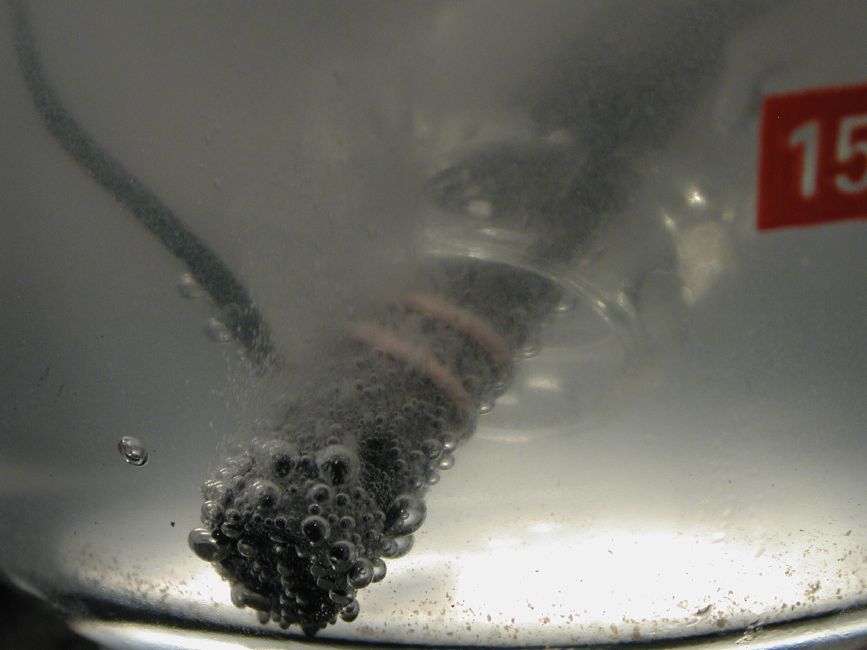
Here is a video of the bubbles forming. The one on the left is making hydrogen: One way to tell is that there is clearly more gas coming off it than off the one on the right. Hydrogen gas is H2 and oxygen is O2. Water is H2O. It's got two atoms of hydrogen for every atom of oxygen, so it stands to reason that you'll get twice as much hydrogen gas.

Putting a tablespoon of salt in the water greatly increases the conductivity, and hence the rate at which gas is formed. Connecting two or more 9V batteries in series also speeds up the process. (You can connect any number of them back-to-back: They just snap together facing each other. Use a separate connector at each end of the chain, or cut one connector in half to separate the two terminals. You can build up to some pretty high voltages with just a handful of batteries, so be careful. In fact, with your hands wet with salt water even a single 9V battery can give you a surprisingly nasty shock. With several in series you should wear rubber gloves, in my opinion.)

Figuring out which gas is which is easy enough: Hold a match near the surface of the water and the bubbles that burn are hydrogen. This is quite safe: They won't explode violently, just burn with little puffs of flame. You may not even see the flame, but you'll hear a crackle. (But see below for some ways in which it can become dangerous.)

If you add salt, you'll also get a simply wonderful smell of chlorine gas, a lot like a swimming pool administered by an overly enthusiastic sanitarian. This means your oxygen gas is not pure, because the chlorine comes off the same terminal as the oxygen. But the hydrogen is pure, because any sodium you electrolyze out will immediately react with the surrounding water, forming more hydrogen and dissolved sodium hydroxide. In other words, the solution will become progressively more basic.

Notice how I'm not telling you whether it's the + or - electrode that makes hydrogen. If you know a little chemistry you can easily figure it out, but I urge you not to. Do the experiment first, determine it by the flame test. Pretend you don't know which is the positive ion: The first people who did this didn't know either.

Here's a picture of the bubbles you'll see with one 9V battery and about a tablespoon of salt in two cups of water:


Once you've got a setup that is making a good quantity of bubbles reliably, you can start collecting the gasses by inverting a bottle or test tube of some sort over one of the electrodes (hint: it's more fun to collect the hydrogen). Start with the bottle completely full of water so your gas won't be mixed with air that was already in the bottle (this is an important safety point as we'll see below).

The main video for this sample shows it being collected, with the capture bottle over the hydrogen electrode. The closer the electrodes, the faster the bubbles flow. Alkaline batteries give you more bubbles: You're actually putting a pretty heavy load on the battery, and it will run dead in maybe 10-15 minutes. It took about 5 minutes to fill my bottle completely full of hydrogen.

If you separate the electrodes and collect each gas separately, you can burn the hydrogen fairly safely just by holding a lit match to the bottle as you uncover the opening. It can't burn too fast, because it has to mix with the oxygen in air before anything happens, and because air is only about 21% oxygen, the rest being non-flamable nitrogen. I would only do this with a small test-tube, never with a narrow-mouthed bottle. You don't want to give it any opportunity to build up pressure inside the bottle. (Yes, I collected this sample in a narrow-mouthed bottle, but I never intended to burn it.)

It's a completely different story if you collect both gasses in the same container. Such a bottle will contain a perfect stoichiometric mixture of pure hydrogen and oxygen: That is a highly explosive mixture because it contains exactly the right proportions needed to burn instantaneously when ignited. If you held a match up to such a bottle, you would get a loud bang and quite likely flying shards of glass. I haven't done it, and I don't think you should either: There are much better ways of making bangs if you want one.

But don't let me scare you off this experiment: As long as you don't combine the two gasses in a container, it's a quite safe experiment, and great fun. It's certainly by far the safest electrolysis you can do, and it's probably the single easiest way to isolate pure elements (two at once!) from an "ore".

This is also the only simple experiment you can do in which, in a very real sense, you create the atoms you're collecting, rather than just separating and purifying them. Think about what a hydrogen atom is: It's nothing more than a single proton, captured in a cloud of negative charge from the electrons surrounding whatever compound it's part of. When you use electricity to split water, you send an electron from the battery down into the water, where it finds a water molecule, rips off a proton, and the proton and electron combine to form a hydrogen atom. (Technically, two electrons rip off two protons and form a molecule containing two hydrogen atoms, but that's a detail.) The point is that by adding electrons to water, you are creating hydrogen atoms out of two subatomic particles. In virtually every other chemical reaction the atoms already have lots of electrons around them, and you're just making changes around the edges. But here you're making the atoms up pretty much from scratch, no accelerator or nuclear reactor required, just a 9V battery.

I recently saw a really sexy device in a chemical catalog. It's a oxy-hydrogen blow torch that runs on just electricity and water: You don't need any gas cylinders to get just about the hottest flame you can get with chemicals. Of course it works by using the electricity to split the water into hydrogen and oxygen, then piping the gas into the torch nozzle where it combines right back into water, releasing the electrical energy you put in as heat. It sounds trivial, but I'm sure there are a lot of tricks they had to use to get it to work, in the same way that a plasma-arc cutting torch sounds easy, but ends up requiring hafnium of all things in the electrode if you want it to actually cut steel.
Source: Theodore Gray
Contributor: Theodore Gray
Date Acquired: 20 August, 2002
Price: $0
Size: 2.5
Purity: >90%

Group:
Non-Metals
Collections:
Elements with Sounds
Fun/Dangerous Experiments
Elements at Walmart
Elements in the Human Body
Elements I Need Samples Of
www.webelements.com
chemicalelements.com
Los Alamos
Royal Society
Environmental Chemistry
Phoenix College
Minerals
X-Ray Properties
Science Fiction Science Fiction Main
Comics
Poetry Poetry Main
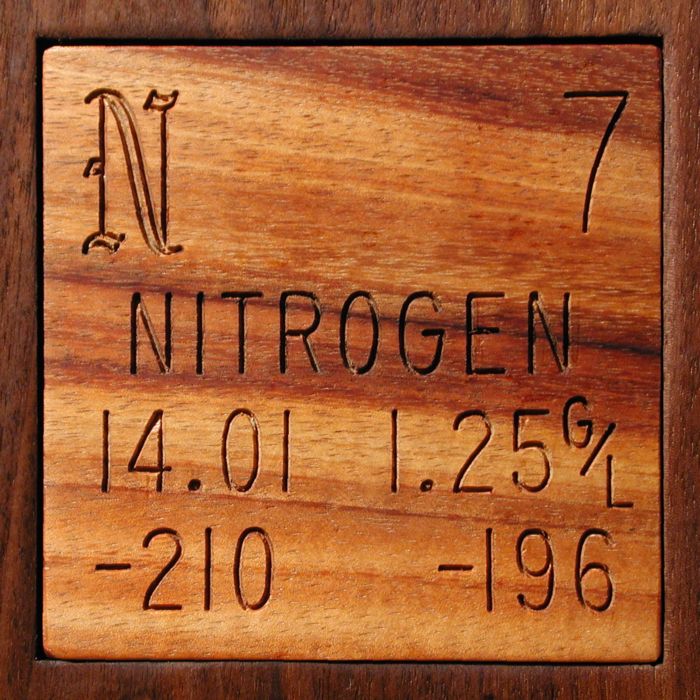
Natural sample, 78% Pure.
I collected this sample of naturally occurring air (78% pure nitrogen) from about 20 feet away from the table in May, 2002. The sound for this sample is a beautiful 78% nitrogen, 21% oxygen wind sound borrowed from ftp://ftp.zib.de/pub/UserHome/Luegger/Urania/Sound/FX-03.WAV .

Liquid nitrogen is the cheapest and most readily available liquefied gas, and as such is perfect for things like freezing a flower or leaf, then shattering it into a thousand pieces with a hammer. I have to admit I've never done this myself, but I've seen it done, and any first-semester chemistry teacher worth his salt will do it for the class eventually. It's just too much fun to skip, even though the educational value is probably somewhat questionable.
Source: Air
Contributor: Theodore Gray
Date Acquired: 18 May, 2002
Price: $0/Free like the air we breathe
Size: 2.5"
Purity: 78%

Group:
Non-Metals
Collections:
Fun/Dangerous Experiments
Elements at Walmart
Elements in the Human Body
Elements that spell OLiVEr SAcKS
www.webelements.com
chemicalelements.com
Los Alamos
Royal Society
Environmental Chemistry
Phoenix College
Minerals
X-Ray Properties
Science Fiction Science Fiction Main
Comics
Poetry Poetry Main
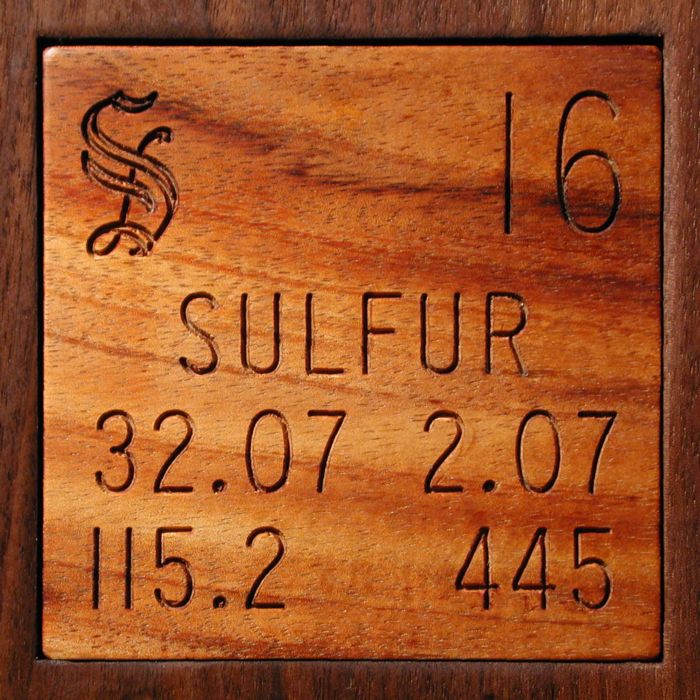
Flowers of sulfur.
This sulfur was purchased at a Walgreens pharmacy in April 2002. They had only one partially used bottle left, which no one knew the use of!
Many years ago I used to buy sulfur and saltpeter from pharmacies to grind up into gunpowder (the carbon came from readily available charcoal). I had to be sure not to buy both sulfur and saltpeter from the same pharmacist. Back then neither seemed to raise any eyebrows, and I don't think I ever had to use my planned excuse that "my mom asked me to buy this for her, I don't know what she's going to do with it".
But in 2002, it seems people don't buy sulfur at the pharmacy anymore. I actually had half seriously planned to say "my wife asked me to buy this for her, I don't know what she's going to do with it", but when the stern-faced pharmacist asked me, staring over his glasses, what I planned to do with it, I broke down and told him the truth. It worked.

I doubt that the truth would have worked for me back in the late 1970s, though you never know. The range of things people think it's reasonable for kids to be playing with has shrunk quite a bit since then. (Or changed anyway: Making pretty fireworks is out, video games where kids practice point-blank killing are in. See my hotheaded rant on the topic.) In any case, I never had trouble buying either sulfur or saltpeter separately, and carbon came from plentiful charcoal.
Making gunpowder is fairly easy, though it's much more difficult if you want it to go bang rather than just burn fast and furiously.
It's basically just a mixture of sulfur, saltpeter, and carbon in a certain proportion (which you can look up in any encyclopedia or on the web). Beyond that, it all depends on how finely ground and intimately intermixed the powder is. To make it explode fast enough to work as gunpowder, the chemicals have to be intermixed down to a nearly molecular level, so that when the ignition wave passes by they can react immediately and contribute to the chain reaction.
The dangerous part of making gunpowder is achieving this intermixing, which requires grinding the components together with each other. Sure, you can grind each component (which can't explode in isolation) individually into a very fine powder. But that's not good enough: In the end you must grind them together in a way that smashes and mixes the grains with each other. When you're doing this, sooner or later it's going to blow.
The old Dupont gunpowder works on the Delaware river had a clever solution for this. The grinding mills were built with three walls of think stone, and one, facing the river, of cheap pine boards. Nobody stood between the mill and the river. This is a beautiful demonstration that you should never constrain an explosive substance, unless you really intend to send things flying. By leaving one wall essentially open, they virtually eliminated the danger of the building exploding in all directions. They are part of a museum and gardens now, having survived many years of gunpowder making.
Now, the Duponts had rolling mills with carved stone tracks, but I used the side of a cinderblock and a metal cold chisel (which had a nice flat surface). This was probably a bad idea: Metal tends to spark on concrete, and sparks are bad. My concession to safety was to only grind a very small amount, maybe a tablespoon at any one time, and keep the rest of it well away. I also had the good fortune of being nearsighted at a young age, so I was wearing glasses at all times, which is the most important thing to be doing any time you're working with reactive chemicals.
And since my gunpowder was very low-intensity, even if it had ever been set off by grinding (which it never was), it probably would not have actually caused much injury.
At first I was quite disappointed that I could not make bang-type gunpowder. It was probably a combination if inadequate grinding, and the fact that charcoal really isn't anything like pure carbon. But I came to realize that my stuff was much more versatile: It was more like pyrotechnic fuel than gunpowder.
I would mix in things like copper filings, then wrap it up in a cone shape, using several sheets of paper for the cone. Lit from the top it would make a several-foot high fountain of colored sparks: Every once in a while one would make a quite respectable display, in my humble opinion.
All in all, I think this was not nearly as dangerous as it might sound, though certainly if I had ever accidentally made really good gunpowder, bad things could have happened. We won't even get into the flash powder rockets: That's a whole other story.

Source: Walgreens Pharmacy
Contributor: Theodore Gray
Date Acquired: 18 April, 2002
Price: $2
Size: 2.5"
Purity: >95%
Crystals.
These are nice lumpy crystals of sulfur. Ah, the memories that smell brings back!
Source: Mark Rollog
Contributor: Mark Rollog
Date Acquired: 20 July, 2002
Price: Donated
Size: 0.3"
Purity: >95%

Group:
Halogens
Collections:
Elements in the Human Body
Elements I Need Samples Of
www.webelements.com
chemicalelements.com
Los Alamos
Royal Society
Environmental Chemistry
Phoenix College
Minerals
X-Ray Properties
Science Fiction Science Fiction Main
Comics
Poetry Poetry Main
Table salt (NaCl).
Kindly contributed by Ed Pegg.
Source: Grocery Store
Contributor: Ed Pegg Jr
Date Acquired: 20 May, 2002
Price: $0.25/pound
Size: 2.5"
Purity: 50%
Sal Ammoniac.
Names from a long time ago. Chemists may call it ammonium chloride, but if you go to a hardware store, it's still Sal Ammoniac ("Salt of Ammon", in the plumbing section), same as it was around the turn of the millenium (not that one, the one before). And even the chemist isn't escaping this history, because the modern name "ammonium" itself comes from Ammoniac, which comes from the fact that the substance was discovered in white crystals that formed on the roof from the burning of camel dung in the Temple of Zeus/Jupiter Ammon in Egypt (or so says the internet).
Today it's used to rub soldering irons on to clean the tips.
Source: Hardware Store
Contributor: Theodore Gray
Date Acquired: 5 August, 2002
Price: $3
Size: 2"
Purity: 50%

Group:
Transition Metals
Collections:
Favorite Samples
Elements with Sounds
Elements at Walmart
Elements in the Human Body
www.webelements.com
chemicalelements.com
Los Alamos
Royal Society
Environmental Chemistry
Phoenix College
Minerals
X-Ray Properties
Science Fiction Science Fiction Main
Comics
Poetry Poetry Main
Steel wool.
This is a bit of the steel wool used to polish the wax finish on the Periodic Table.
Source: Hardware Store
Contributor: Theodore Gray
Date Acquired: 15 April, 2002
Price: $1
Size: 2"
Purity: >95%
Rusty iron plate.
Just some old iron pulled from a junk pile at the farm. The sound is steel plate like this being beaten with a blacksmith's hammer.
See hafnium for some pictures of a plasma-arc cutting torch cutting some steel plate much like this, and see oxygen for a story about how oxy-acetylene cutting torches actually work.
Source: Marco's Scrap Metal
Contributor: Theodore Gray
Date Acquired: 15 April, 2002
Price: $0.10/pound for scrap iron.
Size: 1.5"
Purity: >95%
Precision steel micro-bearings.
We think these balls are about 1/32-inch diameter. Ed Pegg reports that these particular balls were accidentally magnetized by noted physicist Stephen Wolfram, making them unsuitable for Ed's experiments.
Source: New England Miniature Ball Corp
Contributor: Ed Pegg Jr
Date Acquired: 15 April, 2002
Price: $5/1000 (which is not a lot of bearings)
Size: 0.03"
Purity: >95%
Civil war canister shot.
Chris reports that he found this approximately 2.5 inch diameter crude iron ball while walking in the woods in Pennsylvania. I immediately assumed it was a civil war cannonball, because that's the most interesting thing it could be. But a close second, and probably more likely according to a civil war author I asked, is that it's "canister shot", which is like shotgun palettes on a larger scale. Or it could be a crushing ball from a stone tumbler, but that's so boring it just can't be.
Source: Chris Carlson
Contributor: Chris Carlson
Date Acquired: 5 June, 2002
Price: Donated
Size: 2.5"
Purity: >95%

Group:
Transition Metals
Collections:
Elements with Sounds
Elements at Walmart
Elements in the Human Body
www.webelements.com
chemicalelements.com
Los Alamos
Royal Society
Environmental Chemistry
Phoenix College
Minerals
X-Ray Properties
Science Fiction Science Fiction Main
Comics
Poetry Poetry Main
Ingots.
These small ingots are dissolved and electroplated onto bumpers at the Flex-n-Gate manufacturing plant in Urbana, Illinois.
My van had broken down (bad battery) and I was waiting at Peter B's repair shop for them to put in a new one. I noticed I was sitting with nothing to do just across the street from what bills itself as the largest manufacturer of automotive bumpers in the country, Flex-n-Gate. I immediately thought CHROMIUM and took a walk over to their front office.
The receptionist seemed a bit confused about who she should direct me to, but finally went in back to find an engineer: Presumably she thought he would at least know what I was talking about.
The engineer, Douglas Suits, was very understanding, and I showed him some photographs of the Periodic Table on my PowerBook. He said he would check around for some samples, and later that day I went back to pick up an envelope containing this flake for chromium (see) and these two very nice chunks of nickel.
While they receive nickel in metallic form, chromium arrives in the form of chromic acid because that is more convenient for electroplating. So while they probably have more chromium in one place than almost any other place on earth, he was unable to give me any. They have so much nickel they actually have to keep a guard on it because of its value, but presumably no one wants to steal chromic acid!
He explained that bumpers are actually not primarily plated with chromium but rather with nickel. They electroplate 0.0010" of semi-bright nickel, 0.0003" of bright nickel, and only 0.000000066" of chromium onto the base of steel.
Source: Flex-n-Gate, Inc
Contributor: Flex-n-Gate, Inc
Date Acquired: 25 April, 2002
Price: Donated
Size: 1"
Purity: >99%
Plate.
Purchased from Neil Lipson (Lipson@postoffice.att.net) after contact through eBay. This 2.5" rectangle of 1/8" plate is stamped "Ni", indicating it was probably an element sample in a set sold by some educational supply company.
Source: Neil Lipson
Contributor: Theodore Gray
Date Acquired: 29 May, 2002
Price: $10
Size: 2.5"
Purity: >99%
Ball, 99.95%.
Kindly donated by David Franco, who sent many elements after seeing the slashdot discussion, and this one after I sent him some Mathematica t-shirts.
Source: David Franco
Contributor: David Franco
Date Acquired: 11 June, 2002
Price: Donated
Size: 0.3"
Purity: 99.95%
Canadian Quarters.
My Canadian colleague George Beck brought these back from Canada after I read that Canadian quarters before 2001 were made out of almost pure nickel. It's nice to know that the Canadians know how much their money is worth, eh? Rather than unleash this stack of funny money on the american vending machine market, I'm keeping it in the table as a nickel sample.
Source: Canada
Contributor: George Beck
Date Acquired: 12 June, 2002
Price: $10
Size: 2.5"
Purity: >90%

Group:
Halogens
Collections:
Elements I Need Samples Of
www.webelements.com
chemicalelements.com
Los Alamos
Royal Society
Environmental Chemistry
Phoenix College
Minerals
X-Ray Properties
Science Fiction Science Fiction Main
Comics
Poetry Poetry Main
Hot tub salt (NaBr).
Kindly contributed by Ed Pegg.
Source: Hardware Store
Contributor: Ed Pegg Jr
Date Acquired: 20 May, 2002
Price: $1/pound
Size: 2.5"
Purity: <50%

Group:
Other Metals
Collections:
Elements with Sounds
www.webelements.com
chemicalelements.com
Los Alamos
Royal Society
Environmental Chemistry
Phoenix College
Minerals
X-Ray Properties
Science Fiction Science Fiction Main
Comics
Poetry Poetry Main
Ingot.
Purchased by Ed from Randolph Zerr, estuff@aol.com, on eBay in May 2002. Those marks you see in the picture are from people's fingernails: This stuff is very soft!
Source: Randolph Zerr
Contributor: Ed Pegg Jr
Date Acquired: 8 May, 2002
Price: $20/50 grams
Size: 1.5"
Purity: >99%
Crying bars.
When you bend it, indium gives out a "cry" much like the better-known "tin cry" (see tin). Neither of them is really much like a cry, as you can head if you play the sound for this sample.
Source: Mark Rollog
Contributor: Theodore Gray
Date Acquired: 31 July, 2002
Price: $5/each
Size: 2.5"
Purity: >99%

Group:
Alkali Metals
Collections:
Fun/Dangerous Experiments
Elements at Walmart
Elements that spell OLiVEr SAcKS
www.webelements.com
chemicalelements.com
Los Alamos
Royal Society
Environmental Chemistry
Phoenix College
Minerals
X-Ray Properties
Science Fiction Science Fiction Main
Comics
Poetry Poetry Main
Long-life AA battery.
Initially only used in fancy camera batteries, lithium is now available in AA and 9V batteries for use in things like smoke detectors and digital cameras. They are still (2002) much more expensive than regular batteries, but last a lot longer.
The great thing about disposable lithium cells is that the lithium exists in the form of a foil, not some kind of powder you can't separate. Note that this is only true of new, unused disposable lithium batteries. The reaction that powers the battery consumes and fragments the lithium, and you won't get a foil out of a used one. In fact, based on my experience disassembling a fully discharged lithium AA battery, it's not something you would want to do. Shortly after unrolling the coil (see below for more details) the thing actually spontaneously ignited in front of my eyes. Seriously, I opened it up, it started feeling warm, and seconds later the paper towel it was on burst into flames. I've never really had that happen before in quite so spontaneous a way, in my 30-odd years of taking things apart and sometimes trying to make them burn. (I picked up the paper towel from the sides, which were not burning yet, and set it on the concrete floor of the shop for safe burning out.)

I'm not really sure whether this was a unique event (it was extremely humid at the time, which may have contributed). I've never had it happen with a fresh battery, and I'm not planning to repeat the used battery experiment, except maybe to film it some time.

Anyway, back to fresh batteries. To get pure metallic lithium, all you have to do is dissemble the battery and unroll it.

Of course, this is somewhat like saying all you have to do to save the world is clip the right wire on the time bomb. Disassembling a AA lithium battery is not something to be done lightly: It can be quite dangerous. The chemicals inside will burn exposed skin and eyes, and as I can tell you from personal experience, it's entirely possible for it to catch fire completely unprovoked. Eye protection is absolutely, positively required for any experiment involving alkali metals, and you should also work in an area where things can burn themselves out harmlessly. A concrete floor (without spilled oil) is good, or I like to use a cast-iron welding table I got at an auction.
One problem is short circuits. If you short out the terminals of a lithium battery, it will heat up quite rapidly (a second or two), and can become dangerously hot. You may have read about people whose pockets caught fire when they carried these things loose with some change or keys.
The trouble is that when you use diagonal cutters to clip away the fairly tough metal casing, you'll almost certainly make contact with the positive terminal, because that's the only place you can start cutting. The key is to cut away the top as quickly as you can, removing any internal shorts you've created before it blows up in your hands.
Once you've started the cut at the top rim, removed the various disks and rings you'll find at the top, and made sure there are no shorts (as evidenced by the fact that it's not continuing to get hotter), the casing can be pealed back using diagonal cutters or some pliers, until you've exposed enough of the coiled core to pull it out of the casing. Be careful not to puncture the plastic inside, or you'll create more short circuits. If you're foolish enough to have gotten this far, be warned that from here on out, you should definitely be wearing non-flammable gloves. You do not want to touch elemental lithium with your bare hands, especially if you're nervous. (It reacts strongly with moisture, liberating hydrogen gas. On the plus side, this gas will usually not spontaneously catch fire.)
If you clip away the plastic wrap or tape holding the coil together, you can then simply unroll the thing, which will separate into several layers. One is a shiny metal foil that looks a lot like aluminum foil. It is, in fact, aluminum foil, so discard it. Another layer is a black flaky/powdery substance that smells bad. This is the electrolyte, which you should wrap in a plastic bag and discard in a fire-safe way. There are also some plastic layers that are of no interest. What you're after is the dull, soft foil that is probably dark brown by the time you see it. This is the lithium.
Depending on the humidity level, it is almost certainly oxidizing before your very eyes. On a moist midwestern night, the foil will actually stay comfortably warm, simply by the continuous reaction with water in the air. In any case, it will not last long, certainly not a whole day, in the open air.
You could try to preserve it under oil, but what's the fun in that?
Or you could throw a small patch of it into a bowl of water, but of course that would cause it to disintegrate almost instantly in a froth of bubbles, which there is small but real danger could ignite spontaneously. (The reactivity of alkali metals increases as you go down the periodic table. If you throw sodium or potassium into water, the gas most likely will ignite, but with lithium, the reaction usually isn't hot enough to light the gas. At least not in my experience: This could be your chance to make emergency room history.)
See the next sample for another thing you could do with it.
Source: Radio Shack
Contributor: Theodore Gray
Date Acquired: 7 August, 2002
Price: $3
Size: 2"
Purity: >95%
Lithium oxide crystals.
If you had some thin lithium foil (see above) what would you do with it? I thought that maybe I could melt it into a lump, if I bathed the crucible in helium from a small balloon-filling tank (to prevent rapid oxidation) as I heated it from below. I was wrong.
Even with the helium shield gas, the lithium ignited almost immediately, and then proceeded to burn in much the same way lump magnesium does, only much faster (especially after I turned off the helium). This probably means I wasn't getting enough helium around the crucible, and some moist air was working its way in. (Or maybe my helium, which just came from a disposable balloon filling tank, contained an oxygen impurity, which is not at all unlikely. Another possibility is that there was chemical contamination from the battery that permitted combustion.)
I decided to change plans and just let a bigger piece of it (folded up tightly into a lump) burn itself out in the crucible. It lit instantly with a propane torch and burned quite dramatically, and very, very hotly. It actually cracked the tiny thimble-sized ceramic crucible I had it in. (Mind you, this is (was) a high-temperature ceramic crucible intended for burning and melting things in. It's not supposed to crack just because you make it hot.)
It would be interesting to see how different the reaction is in the winter when the humidity is 5% instead of 95%.
Source: Radio Shack
Contributor: Theodore Gray
Date Acquired: 12 August, 2002
Price: $3
Size: 1"
Purity: <50%

Group:
Halogens
Collections:
Elements in the Human Body
Elements I Need Samples Of
www.webelements.com
chemicalelements.com
Los Alamos
Royal Society
Environmental Chemistry
Phoenix College
Minerals
X-Ray Properties
Science Fiction Science Fiction Main
Comics
Poetry Poetry Main
Teflon thread seal tape.
When you screw together cast iron water or gas line pipe, you have to put thread seal compound or tape on the threads first, or else it will leak. The most popular choice is PTFE (polytetrafluoroethylene, otherwise known as teflon) tape, which is a soft, stretchable material that is very slippery and very resistant to chemical attack. This particular roll is pink, which is not characteristic of teflon, it's a dye added to indicate that this is thicker-than-usual tape.
PTFE tape is also a curious demonstration of the power of convention. It always comes on a particular kind of plastic spool, with a particular kind of snap-on cover to keep it clean. Every brand, every manufacturer, every store you look in, it's always exactly the same type of container, which is used for no other kind of tape I that I am aware of. It would be fascinating to know the story of how this came about, but at this point the convention is so strong that if any manufacturer tried to sell teflon tape in a different package, they probably wouldn't sell more than a roll or two. Those would be returned as purchasing errors, because anyone who is looking for teflon tape will be looking for a particular shape of package, and won't even see any that's the wrong shape.
Source: Hardware Store
Contributor: Theodore Gray
Date Acquired: 15 April, 2002
Price: $2
Size: 2"
Purity: 15%

Group:
Non-Metals
Collections:
Elements with Sounds
Fun/Dangerous Experiments
Elements in the Human Body
Elements I Need Samples Of
www.webelements.com
chemicalelements.com
Los Alamos
Royal Society
Environmental Chemistry
Phoenix College
Minerals
X-Ray Properties
Science Fiction Science Fiction Main
Comics
Poetry Poetry Main
Kitchen matches.
Boy, if these were chemicals the warnings on them would be a mile wide. Caution! Pyrophoric! May spontaneously ignite with friction! Wear appropriate protective gear when handling this substance! Never expose to heat or rough handling! Probably the second most dangerous element we have after cesium.

I remember years ago, I couldn't have been more than ten, making rockets out of matches and tin (aluminum) foil. You wrap the head of the match and about half way up the stick in several layers of foil, being sure to seal the part around the head well. Then you prop it head end down on some more foil and hold a lit match to the foil down where the head of the match is. After a few seconds the match inside the foil will light, and the gas generated will propel the match out of the foil barrel and several feet down the sidewalk.
I remember doing this mainly with cardboard matches such as you get in a matchbook, but I don't see why it wouldn't work with kitchen matches too. It works because the match head contains both a fuel and an oxidizer, so you don't need any air inside the foil for the match to burn.

Source: Grocery Store
Contributor: Theodore Gray
Date Acquired: 12 June, 2002
Price: $2
Size: 2"
Purity: <20%

Group:
Transition Metals
Collections:
Elements in the Human Body
www.webelements.com
chemicalelements.com
Los Alamos
Royal Society
Environmental Chemistry
Phoenix College
Minerals
X-Ray Properties
Science Fiction Science Fiction Main
Comics
Poetry Poetry Main
Small rectangle of foil 99.95%.
Kindly donated by David Franco, who sent many elements after seeing the slashdot discussion.
Source: David Franco
Contributor: David Franco
Date Acquired: 17 May, 2002
Price: Donated
Size: 1"
Purity: 99.95%
Cylinder.
Purchased from Neil Lipson (Lipson@postoffice.att.net) after contact through eBay. No information on the source or use of this sample. This stuff is close to the density of lead, but much harder. It's a nice hunk.
Source: Neil Lipson
Contributor: Theodore Gray
Date Acquired: 29 May, 2002
Price: $19
Size: 2"
Purity: >99%
Nut and bolt, broken.
Purchased from Neil Lipson through eBay. This bolt was said to have been from a high-temperature pressure vessel of some sort. If you look at the broken surface in the high-resolution picture, you can clearly see that it's not like any steel, at least not like any I've ever seen. The melting point of molybdenum is a good 1000C higher than steel, and it's pretty strong stuff.
In case you had any lingering doubts about whether someone would pay $13 for a broken 1/4-20 bolt on eBay, the answer is yes.
Source: Neil Lipson
Contributor: Theodore Gray
Date Acquired: 15 August, 2002
Price: $13
Size: 1.5"
Purity: >90%
Tiny cylinder.
Ed bought half a dozen different tiny metal cylinders from David Franco, intending to make some kind of puzzle out of them (Ed's a puzzle person). But they turned out to be too irregular, so he donated them to the table.
Source: David Franco
Contributor: Ed Pegg Jr
Date Acquired: 19 August, 2002
Price: Donated
Size: 0.2"
Purity: 99.98%

Group:
Transition Metals
www.webelements.com
chemicalelements.com
Los Alamos
Royal Society
Environmental Chemistry
Phoenix College
Minerals
X-Ray Properties
Science Fiction Science Fiction Main
Comics
Poetry Poetry Main
2 inch anode ball.
Purchased from eBay seller "El_Three" in May 2002. Similar balls are for sale in 100lb quantities by suppliers who list them as "anode balls". I'm not clear what industrial process they are used for.
Source: eBay seller El_Three
Contributor: Theodore Gray
Date Acquired: 13 May, 2002
Price: $35
Size: 2"
Purity: >95%
Small lump 99.998%.
Kindly donated by David Franco, who sent many elements after seeing the slashdot discussion.
Source: David Franco
Contributor: David Franco
Date Acquired: 17 May, 2002
Price: Donated
Size: 0.2"
Purity: 99.998%

Group:
Alkali Metals
Collections:
Favorite Samples
Elements with Videos
www.webelements.com
chemicalelements.com
Los Alamos
Royal Society
Environmental Chemistry
Phoenix College
Minerals
X-Ray Properties
Science Fiction Science Fiction Main
Comics
Poetry Poetry Main
Sealed glass ampule, 99.98%.
Wow is all I can say about cesium. This substance is as close to liquid gold as you'll ever see, and it really does literally melt in your hand in a matter of seconds. A quite remarkable object, it contains about a gram of 99.98% pure cesium metal.
It's really very sad that if the glass were ever to break, it could very well explode on contact with the surrounding air blinding anyone in the area with flying shards of glass and molten metal. That's why we keep it under lock and key.
Source: David Franco
Contributor: David Franco
Date Acquired: 11 June, 2002
Price: Donated
Size: 2"
Purity: 99.98%

Group:
Rare Earth Metals
Collections:
Elements with Sounds
Elements that spell OLiVEr SAcKS
www.webelements.com
chemicalelements.com
Los Alamos
Royal Society
Environmental Chemistry
Phoenix College
Minerals
X-Ray Properties
Science Fiction Science Fiction Main
Comics
Poetry Poetry Main
Large rectangle of heavy foil.
This fabulous, rather valuable sample of erbium was most graciously donated by George (not 007) Lazenby, who saw the slashdot discussion. I don't know the exact thickness, but it's quite stiff and solid for a foil. A very, very fine specimen.
George got this and the other samples he donated at a surplus auction of his highschool. It seems he was the only one there who appreciated the erbium foil. This sample and the others he sent had been donated to the school by a former student who worked at NIST (National Institute for Standards and Testing), where they had been used as x-ray calibration standards. This means they are probably very pure.
Source: George (not 007) Lazenby
Contributor: George (not 007) Lazenby
Date Acquired: 9 June, 2002
Price: Donated
Size: 2"
Purity: >99.9%

Group:
Other Metals
Collections:
Elements with Sounds
Elements with Videos
Fun/Dangerous Experiments
Elements at Walmart
www.webelements.com
chemicalelements.com
Los Alamos
Royal Society
Environmental Chemistry
Phoenix College
Minerals
X-Ray Properties
Science Fiction Science Fiction Main
Comics
Poetry Poetry Main
Reagent-grade metal.
Around 2001 Stephen Wolfram asked Ed Pegg and me if we could experiment with growing hopper crystals with bismuth. Ed bought some from Alfa Aesar and I brought in my small electric kiln to the office. We were able to create crystals almost immediately: Simply pouring into a stainless steel measuring cup, allowing to cool until the outer edge is solid, then pouring the center off is all it takes. We made several nice small hopper crystals, and it's obvious that one could make any number just by refining the conditions and using more bismuth.
See the fourth sample for a picture of one dish of crystals I made, along with a video showing how the liquid metal is poured off from the crystals.
Source: Alfa Aesar
Contributor: Ed Pegg Jr
Date Acquired: 15 April, 2002
Price: $100/Kg
Size: 2"
Purity: 99.9%
Eggs.
These lovely artificially grown bismuth eggs show what you can do if you learn to control the conditions of crystallization. Based on our experiments, I think it's safe to say these probably take just a few minutes each to make, once you get the system down.
Source: Mr. Bismuth
Contributor: Ed Pegg Jr
Date Acquired: 15 April, 2002
Price: $20
Size: 2"
Purity: >99%
Small crystal, 99.999%.
Kindly donated by David Franco, who sent many elements after seeing the slashdot discussion, and this one after I sent him some Mathematica t-shirts.
This is a nice example of a hopper crystal. Not as big as our other samples, but much more pure of course, since it came from David.
Source: David Franco
Contributor: David Franco
Date Acquired: 11 June, 2002
Price: Donated
Size: 0.2"
Purity: 99.999%
Home-grown crystals.
This small dish of crystals was made from the reagent-grade metal that is the first sample under bismuth. Ed Pegg and I had made several nicer ones long before, but I wanted to make a video showing how you let the metal partially harden, then pour off the still-molten center to reveal the crystals forming from the bottom and outside.
For some reason, this time the metal behaved quite differently. It may have become contaminated with enough of an impurity (lead?) to change its characteristics, or the difference may have had to do with the fact that I was using a plumber's propane torch to heat it, rather than an electric kiln as before.
(I wasn't exactly being careful to control the conditions, as making this video was another one of the things I had to do between bouts of child care.)
In any case, the biggest difference was that this time, it did not form the pretty colored oxide layers. Instead the metal stayed absolutely bright, forming only a dull gray oxide film that was easily skimmed off before it started cooling.
The other difference was that the crystals were smaller, though they were still obviously bismuth-shaped square hopper crystals. This is almost certainly due to less-clean cups and more contamination in the form of particles that initiate crystals from many places at once.
Still, I got a decent dish of crystals, and a decent video of it.
The procedure starts by melting the metal by heating from below until the cup and metal are well above the melting point (it melts very quickly in a propane flame). It's then left to sit for a minute or more, depending on how hot you made it. You want to leave it alone, no shaking, no poking, while it's cooling, because any disturbance will start new crystals and you want to have just a few big one, not lots of small ones.
You want to wait until it's about 50% solid, and of course it will solidify from the outside in, leaving a molten pool in the middle. How can you tell when it's reached this point without disturbing it? You can't, so either guess, or blow lightly on it and watch how much of it wiggles. You can re-melt it as many times as it takes to get lucky, so don't worry if you guess wrong the first few times.
The video for this sample starts when it's reached this 50% solid stage: You see me pick it up (with a glove) and pour the liquid center off into another cup, then immediately zooms in to show the crystals I got. (The cut in the video is because it took several annoying seconds before the auto-focus settled.)
That's all there is to it. It took about half a dozen tries to get one I liked for this video.
Getting the much bigger crystals you see in, for example, the egg sample above probably requires higher purity metal, careful exclusion of unwanted seeds, and more careful control of the cooling time. As a general rule, slower cooling gives bigger crystals, but I really don't know the details for making big bismuth crystals in particular. I'm sure half a day's practice would do wonders for my results, but that's for another decade.
Source: Theodore Gray
Contributor: Theodore Gray
Date Acquired: 11 August, 2002
Price: $10
Size: 2"
Purity: 99.9%

Group:
Rare Earth Metals
Collections:
Elements with Sounds
Elements I Need Samples Of
www.webelements.com
chemicalelements.com
Los Alamos
Royal Society
Environmental Chemistry
Phoenix College
Minerals
X-Ray Properties
Science Fiction Science Fiction Main
Comics
Poetry Poetry Main
Lantern mantel.
Amazingly, Coleman-type camping lanterns contain some radioactive thorium oxide. It's an incandescent material that greatly increases the light output of the lantern when it's heated in the flame. There are non-radioactive alternatives, mainly other rare earth oxides, but they are more expensive. We know this mantle contains radioactive thorium because the donor, who works for the Environmental Health & Safety department at the University of Illinois at Urbana-Champaign, tested it with a Geiger counter.
The sound for this sample is from the Geiger counter.
Source: Hardware Store
Contributor: Trish Craig
Date Acquired: 28 May, 2002
Price: Donated
Size: 2"
Purity: <20%

Group:
Transition Metals
www.webelements.com
chemicalelements.com
Los Alamos
Royal Society
Environmental Chemistry
Phoenix College
Minerals
X-Ray Properties
Science Fiction Science Fiction Main
Comics
Poetry Poetry Main
Healers Fluorite with Rare Earth Element Yttrium.
I admit, I have absolutely no idea if this stone actually has any yttrium in it: See below for a sample that is actual pure yttrium. Honestly, just between you and me, I really just bought this one for the description the seller gave it on eBay: That alone is worth twice the price I paid! And here it is, verbatim from the auction:


Healers Fluorite with Rare Earth Element Yttrium.
Tremendous Healing Energy!

This Beautiful Little Stone Being is a Light Lavender/Peach, looking Peach as the Light Shines through her. Lavender in the Shadow!

Fluorite Stimulates Third Eye Awakening and Understanding! It helps us to See Past the Veils of Illusion to the Beauty and Truth of Awareness. Fluorite Provides Integration of Dark and Light Clearing Us of Heavy Out Dated Energy.

This Combination Stone Being offers Tremendous Healing Energy to her Keeper. She Amplifies our Aura and Helps us Channel Higher Frequency Energy. She helps us Reach the Deep Peace Within enabling us Access to the Higher Knowledge which is Our True Birth Right.

Very Valuable for Teachers and Healers.

Upon first holding these Stone Beings I was amazed at the Hot Flow of Energy they Generate. A Pure Loving Embrace.

The Wonderful Folks who supply these, and myself, feel these Stone Beings need to Get Out in the World. Therefore, starting bid on these will be my cost. Blessings!

From Mexico or Nevada.

Size is 1 7/8" x 3/4" x 1 1/8"

We are Divine Intelligence. Love. It is All There Is. Think of Yourself as a Tiny Cell of Divine Light and Wisdom. ALL BEINGS are Part of The Great Whole. We Carry the Same Cellular Light Memories as The Stone People. WE have Simply (SIMPLY!?!) Forgotten how to Remember! The Stone People are not Complicated with Human Perception. They Simply Are. The Stone People Bring these Memories to Consciousness as We are Ready to Receive them. We Are the Hands of Spirit, the Stone People are Waiting for Us.

They are Here to Help Us do the Work of Spirit.

We Love the Stone People. They are as Individual as you and I. Yet, we are all One. I am finding, as a I look/feel each One, such a Great Love and Open Heart. Each Being, overwhelms me with Its Unique Beauty and Wisdom. I wish you could feel them at that moment as I do. I do not mean that in a Sense that you can't. What I mean is: You know how you feel when your Heart is Wide Open and you want to Share that Energy of Beauty and Joy Everywhere? We Can, you know! According to Theory it Takes 20% of the Human Population to Make the Shift!

Anyway... It is difficult to share what each Being Says. It is only what I hear from the Stone Being and What you Hear may be quite Different. I don't want to quote endless pages from books. I use as a resource and recommend Melody's "Love is in the Earth" for further learning. Really, what I recommend is Feeling their Unique Wisdom, Beauty and Endless Gifts! The Intricacies of Each Being is Quite Amazingly Overwhelming!

They come to Us for a Reason.

To Our Light Within. May It's Brilliance Shine!


Wow.

Source: eBay seller stonepeoplesongs
Contributor: Theodore Gray
Date Acquired: 2 August, 2002
Price: $16
Size: 1.75"
Purity: <1%
Good-sized Lump.
This irregular, obviously mechanically formed lump, is from the irrepressible David Franco, supplier of only the highest purity elements, financed by the ever-generous Ed Pegg. It has conveniently rescued me from a very questionable representation of yttrium.
Source: David Franco
Contributor: Ed Pegg Jr
Date Acquired: 16 August, 2002
Price: $21
Size: 0.5"
Purity: 99.99%

Group:
Noble Gases
Collections:
Elements at Walmart
www.webelements.com
chemicalelements.com
Los Alamos
Royal Society
Environmental Chemistry
Phoenix College
Minerals
X-Ray Properties
Science Fiction Science Fiction Main
Comics
Poetry Poetry Main
Ordinary light bulb.
Exotic light bulbs are filled with xenon or krypton, but ordinary everyday ones are filled with argon, because it's cheap. This one happens to be a burned out bulb from a microscope, I'm using it just because it's the right size to fit in the table.
Source: Theodore Gray
Contributor: Theodore Gray
Date Acquired: 15 April, 2002
Price: Donated
Size: 1.5"
Purity: >90%

Group:
Transition Metals
Collections:
Favorite Samples
Elements with Sounds
Fun/Dangerous Experiments
Elements at Walmart
www.webelements.com
chemicalelements.com
Los Alamos
Royal Society
Environmental Chemistry
Phoenix College
Minerals
X-Ray Properties
Science Fiction Science Fiction Main
Comics
Poetry Poetry Main
One ounce silver rounds.
Purchased in Richmond, CA early 1990s for use in castings. Dan Lewis, a coin dealer, tells me that these are called "silver rounds" because they are round but are not actually coins issued by any government. He reports they are the part of the numismatic world known as exonumia.

I've cast a dozen or so little things out of silver over the years. It's not as expensive as you might think. See zinc for a long story about metal casting.

Source: Coin Shop in California
Contributor: Theodore Gray
Date Acquired: 15 April, 2002
Price: $5/ounce
Size: 1.5"
Purity: 99.9%
Turnings, 99.998%.
Kindly donated by David Franco, who sent many elements after seeing the slashdot discussion, and this one after I sent him some Mathematica t-shirts. My coins are bigger, but his turnings are more pure.
Source: David Franco
Contributor: David Franco
Date Acquired: 11 June, 2002
Price: Donated
Size: 0.2"
Purity: 99.998%
Sassanian Dirham of Chosroes II.
This certainly takes the prize for oldest sample: 1400 years. Dan Lewis, a coin dealer (click on source link below for contact information), sent it for free (!) because it's broken and he thought it would make a good silver sample, which it certainly does. It's quite brittle, which indicates it's not terribly pure, but let's see you do any better 1400 years ago!

I asked him how much he though this coin would have been worth when it was minted. He said he could only guess that because of its size and silver content it was probably fairly valuable, certainly more than a week's wages. So maybe someone bought a horse with it one time, or used a handful to buy a Roman as a slave. Given how long it was probably in circulation, it's no doubt been used to buy a lot of things by a lot of people. History is funny that way, especially when you're holding it in your hand.

Dan sent the following interesting history of this type of coin:
From Ardashir I in 211 A.D. to Yazdegerd III (632-651 A.D.) a series of 42 Sassanian kings ruled over Persia. The Sassanians were ardent devotees of the Zoroastrian doctrine. This fire cult was vigorously disseminated throughout the empire.

In the early period they were the most persistent and successful foe of the Romans. In 260 A.D. the Roman emperor Valerian, while marching through Mesopotamia, was captured and spent the rest of his life as a captive. A century later, in 363 A.D. the Roman emperor Julian II (The Apostate) died from wounds suffered fighting the Sassanians in their capital city of Ctesiphon, near Baghdad. His successor, Jovian, found his situation so perilous that he could only extricate himself and his army by a humiliating peace which ceded many possessions along the Tigres, the great fortress at Nisibis and a Roman pledge to abandon Armenia.

One of the last Sassanian kings, Chosroes II (590-628 A.D.) appears on the obverse of this coin. When his friend and ally the Byzantine Emperor Maurice was assassinated in 602, Chosroes II embarked on an initially successful, protracted campaign of revenge against the Romans. In 614 he invaded and sacked Jerusalem and carried off the remains of the Holy Cross to Ctesiphon. Chosroes fortunes changed when the Byzantine Emperor Heraclius retook lost territories from the Persians and finally in 627 returned the Cross to Jerusalem. This event was well received by Christians who celebrate the event at the annual feast of the Exaltation of the Cross.

Chosroes weakness led to the defeat of the Persians by the Byzantines. During the ensuing revolution Chosroes was deposed and murdered by his son Kavadh II in 628. One hundred years of nearly constant war with the Byzantines and Chosroes incompetence left the Sassanian Empire crippled and vulnerable to their demise at the hands of the emerging Islamic Arabs.

This coin is an example of late 6th and early 7th century Persian craftsmanship during the zenith of the Sassanian Empire. That empire emerged over a ten year period beginning in circa 224 A.D. when King Ardashir I expanded his local fiefdom in Iran to include all of Iran, Iraq, Afghanistan, and much of the remainder of central Asia. He introduced a new coinage with his own crowned portrait on the obverse, his throne and a Zoroastrian fire altar on the reverse and inscriptions in the Pahlavi language. Although the portraits and styles would change with each succeeding reign, the basic design would remain for 450 years. The most significant image change was made by Ardashir's son, Shapur I (241-270 A.D.) when the throne was eliminated and the altar was flanked by two holy figures. Later, mintmarks and regnal dates would appear. Some of the royal crowns that are pictured were reputed to be so heavy with gold and jewels that the wearer had to have them suspended from the ceiling above the throne by chains in order to wear them.

Source: Dan Lewis
Contributor: Dan Lewis
Date Acquired: 18 June, 2002
Price: Donated
Size: 1"
Purity: >90%

Group:
Noble Gases
Collections:
Elements with Sounds
Elements at Walmart
www.webelements.com
chemicalelements.com
Los Alamos
Royal Society
Environmental Chemistry
Phoenix College
Minerals
X-Ray Properties
Science Fiction Science Fiction Main
Comics
Poetry Poetry Main
Flash tube.
Purchased at Radio Shack May 2002. These kinds of tubes are used for photographic flashes.
Source: Radio Shack
Contributor: Theodore Gray
Date Acquired: 10 May, 2002
Price: $5
Size: 1.5"
Purity: >95%

Group:
Transition Metals
Collections:
Elements with Sounds
www.webelements.com
chemicalelements.com
Los Alamos
Royal Society
Environmental Chemistry
Phoenix College
Minerals
X-Ray Properties
Science Fiction Science Fiction Main
Comics
Poetry Poetry Main
Rhenium in Wolframite.
This is basically a fine powder which is said to have been determined by neutron activation analysis to be microscopic inclusions of rhenium in wolframite grains. No reason to doubt the claim. But it is a good bit of money to pay for a powder that, honestly, looks a lot like just about any other powder.
It is described as coming from eastern Transbaikal, Russia (interestingly the tag it came with is marked "E. Transbaikal, U.S.S.R.", indicating that the sample must have been collected some time ago).
Source: Topaz Mineral Explorations
Contributor: Theodore Gray
Date Acquired: 20 July, 2002
Price: $36
Size: 0.001"
Purity: >50%
Old photographic flash bulb.
Back in the dark ages, cameras used one-time-only flash bulbs that ignited a fine wire of something inside a glass bulb. We're not concerned with the something, but rather with the "igniter": these top-quality GE #5 bulbs were advertised as coming with "the guaranteed RHENIUM igniter".
Source: eBay seller erinsplace2001@yahoo.com
Contributor: Theodore Gray
Date Acquired: 1 August, 2002
Price: $1
Size: 1.5"
Purity: >50%
1cm wire.
A very small sample indeed, but since it's from David Franco, it is of course of the highest purity.
Source: David Franco
Contributor: Ed Pegg Jr
Date Acquired: 16 August, 2002
Price: $6
Size: 0.4"
Purity: 99.98%

Group:
Transition Metals
Collections:
Elements with Sounds
Elements at Walmart
www.webelements.com
chemicalelements.com
Los Alamos
Royal Society
Environmental Chemistry
Phoenix College
Minerals
X-Ray Properties
Science Fiction Science Fiction Main
Comics
Poetry Poetry Main
One ounce bullion bar.
I purchased several small bars of gold for spurious reasons in the early 1990s from a coin dealer near Berkeley, California. They added up to one ounce total. In April 2002 I traded them for a single one ounce bar at Specialty Stamp and Coin in Champaign, Illinois (for $25). I then had a 14K gold loop welded to the back of it by Brian Knox jewelers, Champaign, Illinois, so it could be locked down to the table with a length of stainless steel cable.
Pure gold is incredibly soft! It keeps getting bent, but I think if I put a label on it saying "please don't bend the gold" it would only make the problem worse.
Source: Coin Shop in California
Contributor: Theodore Gray
Date Acquired: 15 April, 2002
Price: $400/including loop
Size: 1.5"
Purity: 99.99%

Group:
Transition Metals
Collections:
Elements with Sounds
Elements at Walmart
Elements in the Human Body
www.webelements.com
chemicalelements.com
Los Alamos
Royal Society
Environmental Chemistry
Phoenix College
Minerals
X-Ray Properties
Science Fiction Science Fiction Main
Comics
Poetry Poetry Main
3/0 electrical wire.
This wire was left over from when I rewired the main service entrance at the farm, and installed the backup generator in the early 1990s.
It's been melted down and left to cool in the standard graphite crucible used for several metal samples. The cylinders came out very clean and required only a power wire brushing to bring out the shine. Coated with a light coat of oil to retard tarnishing.
Copper is a good metal for casting: See zinc for more about metal casting.
Source: Hardware Store
Contributor: Theodore Gray
Date Acquired: 15 April, 2002
Price: $1.50/foot
Size: 1.25"
Purity: >99%
Pre-1983 Pennies.
Before 1983, US pennies were made of solid copper. After the price of copper briefly went over a penny per penny, they reconsidered, and now pennies are copper plated zinc.
Source: America
Contributor: Theodore Gray
Date Acquired: 15 April, 2002
Price: $0.01/penny
Size: 0.5"
Purity: >90%
Native Copper.
Found on a beach on one of the Apostle Islands in Lake Superior.
Source: Chris Carlson
Contributor: Lena Carlson
Date Acquired: 11 July, 2002
Price: Donated
Size: 0.6"
Purity: >90%

Group:
Transition Metals
Collections:
Elements with Sounds
Fun/Dangerous Experiments
Elements at Walmart
Elements in the Human Body
www.webelements.com
chemicalelements.com
Los Alamos
Royal Society
Environmental Chemistry
Phoenix College
Minerals
X-Ray Properties
Science Fiction Science Fiction Main
Comics
Poetry Poetry Main
Scrap roof flashing.
I've been melting and casting roof flashing zinc since the late 1970s. But I couldn't find any just now, so I purchased a new bucket of scrap at Marco's scrap metal in Champaign in April 2002. Later I found many pounds of it in my parents' basement.
This metal was melted down and poured into mini-muffin tins to make nice little coins.

The little turtle is something I made by lost wax casting, probably around 1980. Zinc is the perfect metal for a kid to use for casting. It's easily available at a scrap metal dealer (at least it used to be) for next to nothing. It melts at a low enough temperature that you can melt it on the stove, with effort, or with a propane torch. And it's reasonably non-toxic, certainly less toxic than lead.
Arguably tin is the best metal for amateur casting, but it's much more expensive and not generally available as scrap metal unless you live in a large city with exotic scrap dealers. In any case, I didn't have access to tin, but I had plenty of zinc.
Lost wax casting is about as ancient a technology as they come. The first step is to make something out of wax. Any kind will do, but note that paraffin isn't wax, and you can't work it other than to carve it. Beeswax is better, and you should be able to get it at craft stores (candle making section). (I got my supply at an apothecary in Zurich and took it to America in a cloth suitcase. When I picked up the suitcase after the flight, the outside was smeared with a thick layer of greasy-waxy stuff, which of course I assumed must be my wax melted out so as to cause a horror when I went through customs. Turns out my wax was fine, it was just some kind of airplane slime that had gotten on the suitcase.)
Anyway, after you've finished your object, you attach a conical stem also made out of wax, then pour a mold-making compound around the whole thing, leaving just the end of the wax cone sticking out. There are many proper ways of doing this, and many proper mold compounds. I, of course, didn't have any, so I used plaster of paris to make the molds. It's cheap and can be found in any hardware store (in the drywall supplies section).
I would make a cardboard box about 2-3 inches larger on all sides than the wax object, and open on the top. Then I would drip hot wax onto the bottom and stick the top of the wax cone onto it, leaving the object standing up as if it were a wax flower on a wax stem. Next I would stick long pins or needles through the cardboard and into the wax object at several locations (the places that would become high-points inside the mold when it was turned right side up for casting). The pins helped hold the wax object in place, and when removed the holes prevented air pockets.
I would mix up the plaster of paris to a slurry consistency, then pour it into the box. I learned after a while that it was very important to work out air bubbles. Since then I've seen films showing special vibrating machines designed to do exactly this, but I did it by shaking, and by reaching in and swishing my fingers around the object to brush off any bubbles that might be clinging to it.
After the plaster hardened, I would remove the cardboard (which was all soggy), then bake the mold over a tray of aluminum foil to remove the wax.
It takes a very, very long time to bake a mold, all day for a big one. And I definitely learned not to cut corners on the baking time. You've got to make sure all the wax out, and that the plaster has had all its residual water driven out of it. If you try this, you'll probably ruin a few before you believe me on this.
If the mold isn't completely baked, the metal will sputter and bubble when you pour it in, often shooting balls of still-molten metal flying. The only time I've ever burned myself working with metal (or gunpowder) was when a drop like that landed on my hand. After that I wore gloves every time. And of course this ruins the mold too.
Most metals shrink when they harden, which will result in voids in cast object. (There are several methods for avoiding this, but they involve spinning the mold at high speed in a kind of centrifuge. That strikes me as dangerous.) I tried to minimize the problem by letting the mold cool after baking (but not overnight, as it would then absorb moisture again), and then playing a propane torch over the top of the cone of molten metal right after pouring it in. My theory was that this would make the metal harden from the bottom up, drawing in more liquid from the cone as necessary. I'm not sure this had much effect.
Once the metal was solid, I would start dribbling water over the top of the mold, to hasten the cooling process. This was probably dangerous, because if any liquid metal had remained, it could have triggered a steam explosion. But I was of course impatient to see what I'd made! Hot baked plaster of paris is amazingly porous: You can pour a steady stream of water onto it and the water will vanish before it's even spread much over the surface, as if you're pouring it straight into the solid material.
When the metal was well solidified and the water had stopped hissing, I would take a hammer and bash away at the plaster until it cracked open revealing the metal object inside. It took a good bit of cleaning with a screwdriver and wire brush to get all the plaster off. And of course I always had to cut and file off the filling stem, along with any bumps caused by bubbles, and the little whiskers from the needle holes.
I'm not saying this is the best way to do lost wax casting: It isn't. It's just the way I did it.

Other good metals for casting include lead which is very easy to melt and easy to get at hardware stores, but is toxic enough to worry about especially if you file or sand it.
Copper and its alloys brass and bronze are of course the classic casting metals of antiquity, along with silver. Copper is easy to get from scraps and cutoffs of electrical wire, and it's not poisonous. Silver is much more expensive, but not as bad as you might think. $50 will buy enough silver rounds from a coin shop to make several nice objects. Unfortunately the melting points of copper and silver are high enough that you have to use something hotter than a stove top to melt it. A charcoal fire with a blower would do, or a plumbers torch with MAPP gas (for very small amounts). An electric crucible is ideal, but expensive. There's also a recently discovered technique for casting metals with a microwave oven. Ask your mom first.

The other really good metals for casting are tin and aluminum. I've never had enough tin cheap enough to do much with, so I can't tell you any specifics. It's probably a lot like lead. Aluminum melts higher than zinc, tin, and lead, but not nearly as high as copper. An electric kiln or propane torch will work. Aluminum is really easy, you can get it from cans, broken window frames, old pots, whatever.

Source: Marco's Scrap Metal
Contributor: Theodore Gray
Date Acquired: 15 April, 2002
Price: $1/pound for scrap zinc
Size: 1.25"
Purity: >90%

Group:
Rare Earth Metals
Collections:
Elements with Sounds
Elements at Walmart
Radioactive Elements
www.webelements.com
chemicalelements.com
Los Alamos
Royal Society
Environmental Chemistry
Phoenix College
Minerals
X-Ray Properties
Science Fiction Science Fiction Main
Comics
Poetry Poetry Main
Smoke detector element.
I'm told it's illegal to disassemble a smoke detector and remove the tiny radioactive dot that is contained in every ionization detector. But I did anyway, using an old one in May 2002. Considering that probably many thousands of these are disposed of (also technically illegally) in the garbage every year, I'm hardly the only one to mishandle the dots. My americium dot is now contained in a glued-shut box with a glass top that is harder to disassemble than the smoke detector was, and then inside a lead cup with a lid, just so our personnel manager doesn't freak out. (It was my first radioactive sample, but has since been vastly surpassed in radioactivity by the Fiestaware bowl.)
This article by Ken Silverstein:
http://fp2.antelecom.net/brianb/Download%20Files/Nuke%20Kid%20On%20The%20Block.pdf (first published as "The Radioactive Boy Scout" in Harper's Magazine, November 1998) describes the amazing case of a teenage boy who did incredible (and incredibly dangerous) things with smoke detector americium.
The sound is from the Geiger counter: I think most of the radioactivity is shielded by the glass cover glued in place over this sample, so it's not really representative (an unshielded one registers about 2000 counts per minute).
Source: Hardware Store
Contributor: Theodore Gray
Date Acquired: 15 May, 2002
Price: $10/smoke detector
Size: 0.075"
Purity: >90%
Intact smoke detector.
This is the outer casing of the ionization chamber inside an ordinary smoke detector, along with the text from the label on the back indicating its Americium content.
Source: Hardware Store
Contributor: Theodore Gray
Date Acquired: 18 August, 2002
Price: $10/smoke detector
Size: 1.25"
Purity: >90%

Group:
Metalloids
www.webelements.com
chemicalelements.com
Los Alamos
Royal Society
Environmental Chemistry
Phoenix College
Minerals
X-Ray Properties
Science Fiction Science Fiction Main
Comics
Poetry Poetry Main
Outrageous price quote.
Our first attempt at a boron sample involved Ed calling up a chemical supplier. They helpfully supplied a price quote of $2030 (two thousand and thirty dollars American) for one square inch of boron foil. We respectfully declined the offer. You might think that boron would be fairly inexpensive, given that it's dirt common and is the major component of things like Borax. But it turns out it's insanely difficult to fuse and work with, so formed shapes of it are quite unreasonably priced. We are preserving this price quote as a reminder of how much money can be saved by using eBay instead of chemical companies.
Source: Ed Pegg Jr
Contributor: Ed Pegg Jr
Date Acquired: 15 July, 2002
Price: $0/Nothing
Size: 1"
Purity: 0%
Very Odd Lump.
This is a strange-looking lump of solid pure boron. It has several different kinds of surfaces, as you can see if you click on the picture to see the large version. I would love to know more about the means by which this lump was made.
And as you can see below, it was considerably more cost effective than our first attempted sample.
Source: David Franco
Contributor: Ed Pegg Jr
Date Acquired: 16 August, 2002
Price: $12
Size: 0.5"
Purity: 99.9%

Group:
Transition Metals
Collections:
Elements at Walmart
www.webelements.com
chemicalelements.com
Los Alamos
Royal Society
Environmental Chemistry
Phoenix College
Minerals
X-Ray Properties
Science Fiction Science Fiction Main
Comics
Poetry Poetry Main
Powder, 99.98%.
Kindly donated by David Franco, who sent many elements after seeing the slashdot discussion, and this one after I sent him some Mathematica t-shirts.
Source: David Franco
Contributor: David Franco
Date Acquired: 11 June, 2002
Price: Donated
Size: 0.005"
Purity: 99.98%
Barbell (Enslaved).
Niobium seems to be used for jewelry, presumably because it's non-reactive and can be colored by oxidation (the color depending on how long you heat it for). This one is meant to be stuck in some part of your body, I'm not sure which. It came with a gold-colored coating, which I removed using a rotating brass wire brush. Hopefully that wasn't all the niobium in it: Hopefully it's solid niobium and what I removed was niobium oxide.
Source: eBay seller pinta-beads
Contributor: Theodore Gray
Date Acquired: 10 July, 2002
Price: $10
Size: 1"
Purity: >80%
Powder.
This is niobium powder. That's really all there is to say about it.
Source: Mark Rollog
Contributor: Theodore Gray
Date Acquired: 31 July, 2002
Price: $6
Size: 0.005"
Purity: >99%
Tiny cylinder.
Ed bought half a dozen different tiny metal cylinders from David Franco, intending to make some kind of puzzle out of them (Ed's a puzzle person). But they turned out to be too irregular, so he donated them to the table.
Source: David Franco
Contributor: Ed Pegg Jr
Date Acquired: 19 August, 2002
Price: Donated
Size: 0.2"
Purity: 99.98%

Group:
Transition Metals
www.webelements.com
chemicalelements.com
Los Alamos
Royal Society
Environmental Chemistry
Phoenix College
Minerals
X-Ray Properties
Science Fiction Science Fiction Main
Comics
Poetry Poetry Main
Small rectangle of 0.01mm foil, 99.999%
We didn't expect anyone to send us free gold and platinum, but this is pretty close! This small sample was kindly donated by George (not 007) Lazenby, who saw the slashdot discussion. It came in a lovely little plastic vial.
George got this and the other samples he donated at a surplus auction of his highschool. It seems he was the only one there who appreciated the erbium foil. This sample and the others he sent had been donated to the school by a former student who worked at NIST (National Institute for Standards and Testing), where they had been used as x-ray calibration standards. This means they are probably very pure.
Source: George (not 007) Lazenby
Contributor: George (not 007) Lazenby
Date Acquired: 24 May, 2002
Price: Donated
Size: 1"
Purity: 99.999%

Group:
Transition Metals
Collections:
Favorite Samples
Elements with Sounds
www.webelements.com
chemicalelements.com
Los Alamos
Royal Society
Environmental Chemistry
Phoenix College
Minerals
X-Ray Properties
Science Fiction Science Fiction Main
Comics
Poetry Poetry Main
Plasma cutter electrode.
Plasma cutters are really neat: You can cut thick steel using nothing but electricity and air. No acetylene, no fuel of any sort, just the iron burning in air. Jim uses one on our farm to make metal art. Here's a picture of the arc plasma as it's reaching out to the metal, a fraction of a second before the metal ignites:

Here it is just after the metal ignites:

The sound for this sample is the sound of this plasma torch: The quieter sound at the start is the sound of the compressed air blowing out of the tip before the arc starts. Then it ignites and becomes much louder, and towards the end shuts off again leaving just the air sound.
Oh, wait, I guess I should explain what this has to do with hafnium! Ed found out that in the center of the electrode for just about any air-based plasma torch there is a small button of hafnium! Very strange where you find these elements. I think the ones in our torch have such a button, but they are chrome colored and it's hard to see. I went to my favorite welding shop and asked to pick out one where the dot was most prominent. This one shows a nice color contrast. I had planned to pay for the tip, but I guess he thought it was such a strange request he'd just give it to me.
Source: Claudin Welding Supply
Contributor: Claudin Welding Supply
Date Acquired: 24 July, 2002
Price: Donated
Size: 1"
Purity: >90%

Group:
Other Metals
www.webelements.com
chemicalelements.com
Los Alamos
Royal Society
Environmental Chemistry
Phoenix College
Minerals
X-Ray Properties
Science Fiction Science Fiction Main
Comics
Poetry Poetry Main
0.1mm foil wrapped into small cylinder, 99.99%
This small sample was kindly donated by George (not 007) Lazenby, who saw the slashdot discussion. It came in a lovely little plastic vial taped shut with a warning attached not to open it, and a MSDS on Thallium. We haven't opened it.
George got this and the other samples he donated at a surplus auction of his highschool. It seems he was the only one there who appreciated the erbium foil. This sample and the others he sent had been donated to the school by a former student who worked at NIST (National Institute for Standards and Testing), where they had been used as x-ray calibration standards. This means they are probably very pure.
Source: George (not 007) Lazenby
Contributor: George (not 007) Lazenby
Date Acquired: 24 May, 2002
Price: Donated
Size: 1"
Purity: 99.99%

Group:
Transition Metals
Collections:
Elements in the Human Body
www.webelements.com
chemicalelements.com
Los Alamos
Royal Society
Environmental Chemistry
Phoenix College
Minerals
X-Ray Properties
Science Fiction Science Fiction Main
Comics
Poetry Poetry Main
Small lump 99.95%.
Kindly donated by David Franco, who sent many elements after seeing the slashdot discussion.
Source: David Franco
Contributor: David Franco
Date Acquired: 17 May, 2002
Price: Donated
Size: 0.2"
Purity: 99.95%
Fine Powder.
This is a fine powder of manganese. Gets on everything. Weighs more than you'd expect for a powder. Highly toxic.
Source: Mark Rollog
Contributor: Theodore Gray
Date Acquired: 20 July, 2002
Price: $7
Size: 0.0001"
Purity: >99%
Lots of lumps.
This is about a pound of lumps similar to the one I got from David Franco (see above). Since I know Franco sends only the very purest of samples, and since these look identical to the one he sent, I feel reasonably confident in assigning them a similar purity. They were obviously created by the same basic process.
Source: eBay seller snooj
Contributor: Theodore Gray
Date Acquired: 22 August, 2002
Price: $10
Size: 0.75"
Purity: 99.9%

Group:
Noble Gases
Collections:
Elements at Walmart
www.webelements.com
chemicalelements.com
Los Alamos
Royal Society
Environmental Chemistry
Phoenix College
Minerals
X-Ray Properties
Science Fiction Science Fiction Main
Comics
Poetry Poetry Main
Flashlight bulb.
High-intensity bulbs promote themselves as being filled with Krypton instead of the more common Argon filling. Purchased from Menards in May 2002.
Source: Hardware Store
Contributor: Theodore Gray
Date Acquired: 10 May, 2002
Price: $2
Size: 0.75"
Purity: >90%

Group:
Transition Metals
Collections:
Elements at Walmart
www.webelements.com
chemicalelements.com
Los Alamos
Royal Society
Environmental Chemistry
Phoenix College
Minerals
X-Ray Properties
Science Fiction Science Fiction Main
Comics
Poetry Poetry Main
Rhodium plated Ring with Tanzanite.
Ed got this from eBay. Maybe some day he'll get a solid rhodium ring, but he probably won't donate it to my table.
Source: MrValue Jewelry
Contributor: Ed Pegg Jr
Date Acquired: 20 July, 2002
Price: $10
Size: 0.75"
Purity: >90%
1cm wire.
A very small sample indeed, but since it's from David Franco, it is of course of the highest purity.
Source: David Franco
Contributor: Ed Pegg Jr
Date Acquired: 16 August, 2002
Price: $1
Size: 0.4"
Purity: 99.9%

Group:
Rare Earth Metals
www.webelements.com
chemicalelements.com
Los Alamos
Royal Society
Environmental Chemistry
Phoenix College
Minerals
X-Ray Properties
Science Fiction Science Fiction Main
Comics
Poetry Poetry Main
Lump with interesting surface. 99.95%.
On the NPR program I was a guest on (archive) the guest before me was John Emsley, author of "The 13th Element" which is all about Phosphorous, and a recent book that is a survey of all the elements. On the radio he said that the distinguishing characteristic of Thulium is that it is the most useless element. He could find no applications whatsoever to include in its section of his new book. That's pretty neat, I think.
But despite the fact that it is utterly useless, someone mines it, purifies it, and sells it, so we have some.
Source: Stanford Materials Corporation
Contributor: Ed Pegg Jr
Date Acquired: 26 July, 2002
Price: $80
Size: 0.75"
Purity: 99.95%

Group:
Noble Gases
Collections:
Elements at Walmart
www.webelements.com
chemicalelements.com
Los Alamos
Royal Society
Environmental Chemistry
Phoenix College
Minerals
X-Ray Properties
Science Fiction Science Fiction Main
Comics
Poetry Poetry Main
Tiny neon bulb.
This bulb was extracted from a 120V indicator lamp purchased at Radio Shack in May 2002.
Source: Radio Shack
Contributor: Theodore Gray
Date Acquired: 10 May, 2002
Price: $2
Size: 0.5"
Purity: >95%

Group:
Alkali Metals
Collections:
Fun/Dangerous Experiments
Elements in the Human Body
www.webelements.com
chemicalelements.com
Los Alamos
Royal Society
Environmental Chemistry
Phoenix College
Minerals
X-Ray Properties
Science Fiction Science Fiction Main
Comics
Poetry Poetry Main
Lump, 99.95%.
Kindly donated by David Franco, who sent many elements after seeing the slashdot discussion, and this one after I sent him some Mathematica t-shirts.
If I had more of it, I'd throw some in my lake, just to be sure it's really true that the hydrogen gas liberated by the reaction of sodium and water will be ignited by the heat of said reaction, causing not only a lot of fizzing but also an explosion. I would practice my throws first, then throw it really far.
Source: David Franco
Contributor: David Franco
Date Acquired: 11 June, 2002
Price: Donated
Size: 0.5"
Purity: 99.95%

Group:
Other Metals
Collections:
Elements with Sounds
www.webelements.com
chemicalelements.com
Los Alamos
Royal Society
Environmental Chemistry
Phoenix College
Minerals
X-Ray Properties
Science Fiction Science Fiction Main
Comics
Poetry Poetry Main
Round ingots.
Purchased by Ed from Randolph Zerr, estuff@aol.com, on eBay in May 2002. Ed had been thinking about a puzzle where the trick would involve melting some gallium by holding the puzzle in your hand long enough. He now finds that it takes way too long before your hand actually melts the gallium.
Source: Randolph Zerr
Contributor: Ed Pegg Jr
Date Acquired: 8 May, 2002
Price: $50/20 grams
Size: 0.5"
Purity: >99%

Group:
Transition Metals
www.webelements.com
chemicalelements.com
Los Alamos
Royal Society
Environmental Chemistry
Phoenix College
Minerals
X-Ray Properties
Science Fiction Science Fiction Main
Comics
Poetry Poetry Main
Very fine powder (technically "sponge").
This is one of the finest powders I've seen: Very, very powdery. It's also a very unusual color, somehow. Lighter than most powders, in a chocolaty sort of way. Think coffee with a whole lot of milk in it, but less brown and more gray. And of course it's no doubt very pure.
Source: David Franco
Contributor: Ed Pegg Jr
Date Acquired: 16 August, 2002
Price: $22
Size: 0.5"
Purity: 99.99%

Group:
Rare Earth Metals
Collections:
Elements with Sounds
Elements with Videos
Fun/Dangerous Experiments
Elements I Need Samples Of
www.webelements.com
chemicalelements.com
Los Alamos
Royal Society
Environmental Chemistry
Phoenix College
Minerals
X-Ray Properties
Science Fiction Science Fiction Main
Comics
Poetry Poetry Main
Rare earth magnet.
Neodymium magnets are very brittle and are therefore often plated with nickel. Ed Pegg demagnetized one of his magnets (to protect any laptop computers put on the table over the element), and I chipped away some of the plating. We think this is probably about 30% neodymium.
These are dangerously strong magnets! In fact they are so strong you can levitate bits of pyrolytic graphiteover them, as you can see in the video.
Source:
Force Field
Contributor: Ed Pegg Jr
Date Acquired: 15 April, 2002
Price: $3
Size: 0.5"
Purity: <35%

Group:
Transition Metals
Collections:
Elements with Sounds
Elements I Need Samples Of
www.webelements.com
chemicalelements.com
Los Alamos
Royal Society
Environmental Chemistry
Phoenix College
Minerals
X-Ray Properties
Science Fiction Science Fiction Main
Comics
Poetry Poetry Main
Antique phonograph needle.
People playing antique phonograph cylinders (the kind that are played acoustically with no electronics between the needle and the speaker) care a lot about their needles. Probably this is because every time they play a cylinder, an irreplaceable historical artifact is irreparably damaged a little bit more, how much depending on what needle you're using.
Fortunately, some people are transferring and archiving the recordings. The sound for this sample is a short excerpt of a wax cylinder recording taken from the website of a person who offers to transfer wax recordings to CD in exchange for a copy of them.
In any case, the preferred material for needles is of course diamond, with sapphire a good second. But, as was very nicely explained in the letter that came with this fine needle, if you're going to use a metal needle to get a certain kind of tone, an osmium one will last much longer, and leave fewer shards of metal stuck in the grooves, than will a steel needle.
My microscopic examination reveals no joints in the metal, and Randall Anderson, the source, explains as follows:

"Yes they are all osmium. The tungsten ones usually have just a tip, or a central shaft set in brass, but the osmium ones are usually all the way. The thicker the needle the louder the tone, thus they come in soft, medium, and loud tone. The last of the manufacturers went out of business in the late 1970's. I bought out their final inventory. Only NOS (New Old Stock) exist at this point."

On the other hand, the needle is quite unmistakably attracted to a magnet, which it should not be if it were solid osmium. It might be plated, or it might be one of several osmium/iron allows that are discussed in connection with phonograph needles.

Source: eBay seller hmv@houston.rr.com
Contributor: Theodore Gray
Date Acquired: 12 July, 2002
Price: $9
Size: 0.5"
Purity: <50%

Group:
Alkali Earth Metals
www.webelements.com
chemicalelements.com
Los Alamos
Royal Society
Environmental Chemistry
Phoenix College
Minerals
X-Ray Properties
Science Fiction Science Fiction Main
Comics
Poetry Poetry Main
Crystalline lumps, 99.9%.
Ed Pegg got these little lumps of pure beryllium from Tom Salow.
Source: Tom Salow
Contributor: Ed Pegg Jr
Date Acquired: 18 July, 2002
Price: $10/gram
Size: 0.4"
Purity: 99.9%

Group:
Rare Earth Metals
www.webelements.com
chemicalelements.com
Los Alamos
Royal Society
Environmental Chemistry
Phoenix College
Minerals
X-Ray Properties
Science Fiction Science Fiction Main
Comics
Poetry Poetry Main
Cube under oil.
This is a substantial cube of a relatively reactive rare earth (hence the "under oil" part). Praseodymium has the distinction of being one of only two elements whose names are so long I was forced to use a smaller font size when engraving their tiles. (Quite a few others required that I manually cramp the inter-letter spacing, but only two were so hopeless I had to use smaller letters.)
Source: David Franco
Contributor: Ed Pegg Jr
Date Acquired: 16 August, 2002
Price: $43
Size: 0.4"
Purity: 99.99%

Group:
Transition Metals
Collections:
Elements at Walmart
Elements in the Human Body
www.webelements.com
chemicalelements.com
Los Alamos
Royal Society
Environmental Chemistry
Phoenix College
Minerals
X-Ray Properties
Science Fiction Science Fiction Main
Comics
Poetry Poetry Main
Small crystal lumps 99.9%.
Kindly donated by David Franco, who sent many elements after seeing the slashdot discussion. Very attractive little bits of metal!
Source: David Franco
Contributor: David Franco
Date Acquired: 17 May, 2002
Price: Donated
Size: 0.3"
Purity: 99.9%
Electroplated foil.
This is a thin foil of chromium electroplated on nickel foil, from the Flex-n-Gate manufacturing plant in Urbana, Illinois.
My van had broken down (bad battery) and I was waiting at Peter B's repair shop for them to put in a new one. I noticed I was sitting with nothing to do just across the street from what bills itself as the largest manufacturer of automotive bumpers in the country, Flex-n-Gate. I immediately thought CHROMIUM and took a walk over to their front office.
The receptionist seemed a bit confused about who she should direct me to, but finally went in back to find an engineer: Presumably she thought he would at least know what I was talking about.
The engineer, Douglas Suits, was very understanding, and I showed him some photographs of the Periodic Table on my PowerBook. He said he would check around for some samples, and later that day I went back to pick up an envelope containing this flake for chromium and two very nice chunks of nickel (see).
Unfortunately, while they receive nickel in metallic form, chromium arrives in the form of chromic acid because that is more convenient for electroplating. So while they probably have more chromium in one place than almost any other place on earth, he was unable to give me any. They have so much nickel they actually have to keep a guard on it because of its value, but presumably no one wants to steal chromic acid!
He explained that bumpers are actually not primarily plated with chromium but rather with nickel. They electroplate 0.0010" of semi-bright nickel, 0.0003" of bright nickel, and only 0.000000066" of chromium onto the base of steel.
Source: Flex-n-Gate, Inc
Contributor: Flex-n-Gate, Inc
Date Acquired: 25 April, 2002
Price: Donated
Size: 0.3"
Purity: >99%
Granular powder.
This is a nice dense granular powder of metallic chromium. Weighs more than you'd expect for a powder.
Source: Mark Rollog
Contributor: Theodore Gray
Date Acquired: 20 July, 2002
Price: $8
Size: 0.01"
Purity: >99%
Vapor grown crystals.
These small crystals came with a helpful little card, which states as follows: "These crystals are produced in a high vacuum chamber. The chamber is heated to the point where the metal vaporizes and sublimates onto a glass substrate."
Source: SoCal (Nevada), Inc
Contributor: Ed Pegg Jr
Date Acquired: 5 August, 2002
Price: $10
Size: 0.1"
Purity: >99%

Group:
Alkali Earth Metals
www.webelements.com
chemicalelements.com
Los Alamos
Royal Society
Environmental Chemistry
Phoenix College
Minerals
X-Ray Properties
Science Fiction Science Fiction Main
Comics
Poetry Poetry Main
Rough octahedra under oil.
I'm not sure what process resulted in these shapes: They look sort of crystal-like in overall shape, but the surface looks more mechanically-formed than crystalline. As an alkali earth, barium is reactive enough that it must be kept under oil to prevent rapid deterioration into barium oxide.
Source: David Franco
Contributor: Ed Pegg Jr
Date Acquired: 16 August, 2002
Price: $23
Size: 0.3"
Purity: 99.5%

Group:
Transition Metals
Collections:
Elements in the Human Body
Elements that spell OLiVEr SAcKS
www.webelements.com
chemicalelements.com
Los Alamos
Royal Society
Environmental Chemistry
Phoenix College
Minerals
X-Ray Properties
Science Fiction Science Fiction Main
Comics
Poetry Poetry Main
Bottle of antique vanadium lumps.
A lot of people seem to have an element or two in their attic. Much to my delight, after a few decades they start to wonder why, and when they hear about my periodic table project, they decide that I can give their elements a good home where they will be lovingly cared for and displayed for the enjoyment of the whole world. My interview on NPR's Science Friday radio show general several donations like this, including a highly radioactive Fiestaware bowl. But I was amazed when the producer of the show, Charles Bergquist, himself said "oh by the way, I have these elements that have been sitting around...". He donated vanadium, which is the second-hardest-to-get element in the first complete row of 18 elements (second only to scandium, which is truly hard to get).
The lumps were all covered with a thick layer of oxide from decades of exposure to the air, but I've scraped off one of them so you can see the solid metal that remains inside each lump. They are far from consumed by oxidation. For the time being I'm going to leave them alone, because cleaning them would only accelerate the oxidation process. Some day I plan to find a source for sealable clear mylar bags that I can fill with helium to preserve these sorts of samples. Then I'll carefully clean all the oxide off and seal the shiny lumps up in a bag.
Source: Charles Bergquist
Contributor: Charles Bergquist
Date Acquired: 14 August, 2002
Price: Donated
Size: 0.1
Purity: >99%
Tiny cylinder.
Ed bought half a dozen different tiny metal cylinders from David Franco, intending to make some kind of puzzle out of them (Ed's a puzzle person). But they turned out to be too irregular, so he donated them to the table.
Source: David Franco
Contributor: Ed Pegg Jr
Date Acquired: 19 August, 2002
Price: Donated
Size: 0.2"
Purity: >99%
Vanadium Emerald.
This is a simply lovely pale green emerald which gets its green color from an impurity of vanadium, as discussed in Uncle Tungsten. It was sold with the intention that it be cut into a jewel, but I think it's lovely just the way it is.
The sellers, Ray Gaetan and Jill St. Michael, supplied the following information about vanadium emeralds:

Emeralds vary in color from light to deep green. It's commonly thought that an emerald's color derives from the presence of chromium and/or vanadium, replacing some of the aluminum in the mineral's structure. The stone can, however, lose its color when heated strongly.

The emerald belongs to the beryl family of minerals that include aquamarine (the March birthstone), heliodor and morganite. Beryl, or beryllium aluminum silicate in chemical jargon, is a six-sided symmetrical crystal. Beryl contains beryllium, aluminum, silicon and oxygen.

Emeralds are most frequently found inside a form of shale -- a fine grained sedimentary rock. Emerald-bearing shale has undergone recrystallization due to changes in the physical environment such as pressure and temperature. Colombia produces the largest and highest quality emeralds. They were also discovered, and subsequently mined, in the Ural Mountains of Russia around 1830. In the United States, emeralds can be found in North Carolina. Around the world, they also occur in Zambia, Brazil, Pakistan, Norway, Austria, India, Malagasy and Australia.
Emerald is a variety of the species beryl. Its chemical composition is a combination of beryllium aluminum silicate and it appears as a colorless crystal in its pure state. Trace elements present in the chemical mix cause the colors of the various beryl varieties. The elements that can cause the green in beryl are chromium, vanadium or iron. In order to be considered a true emerald, the Gemological Institute of America states that a beryl crystal must be colored green by the element chromium or vanadium or both.
http://webmineral.com/data/Beryl.shtml

Source: eBay seller rrgaetan@san.rr.com
Contributor: Theodore Gray
Date Acquired: 22 August, 2002
Price: $10
Size: 0.15"
Purity: <2%

Group:
Metalloids
www.webelements.com
chemicalelements.com
Los Alamos
Royal Society
Environmental Chemistry
Phoenix College
Minerals
X-Ray Properties
Science Fiction Science Fiction Main
Comics
Poetry Poetry Main
Small crystal 99.9999%.
Kindly donated by David Franco, who sent many elements after seeing the slashdot discussion.
Source: David Franco
Contributor: David Franco
Date Acquired: 17 May, 2002
Price: Donated
Size: 0.2"
Purity: 99.9999%

Group:
Metalloids
www.webelements.com
chemicalelements.com
Los Alamos
Royal Society
Environmental Chemistry
Phoenix College
Minerals
X-Ray Properties
Science Fiction Science Fiction Main
Comics
Poetry Poetry Main
Small crystal, 99.999%.
Kindly donated by David Franco, who sent many elements after seeing the slashdot discussion, and this one after I sent him some Mathematica t-shirts.
This is a very fine shiny and very pure crystal.
Tellurium is my favorite element name because I once defused a brewing trademark problem by convincing a guy that "Tellurium" would be a better name than "Wolfram" for his planned software.
Source: David Franco
Contributor: David Franco
Date Acquired: 11 June, 2002
Price: Donated
Size: 0.2"
Purity: 99.999%

Group:
Rare Earth Metals
www.webelements.com
chemicalelements.com
Los Alamos
Royal Society
Environmental Chemistry
Phoenix College
Minerals
X-Ray Properties
Science Fiction Science Fiction Main
Comics
Poetry Poetry Main
Small crystals, 99.95%.
Kindly donated by David Franco, who sent many elements after seeing the slashdot discussion, and this one after I sent him some Mathematica t-shirts.
Source: David Franco
Contributor: David Franco
Date Acquired: 11 June, 2002
Price: Donated
Size: 0.2"
Purity: 99.95%

Group:
Alkali Earth Metals
Collections:
Elements in the Human Body
www.webelements.com
chemicalelements.com
Los Alamos
Royal Society
Environmental Chemistry
Phoenix College
Minerals
X-Ray Properties
Science Fiction Science Fiction Main
Comics
Poetry Poetry Main
Small lump 99.5%.
Kindly donated by David Franco, who sent many elements after seeing the slashdot discussion.
Source: David Franco
Contributor: David Franco
Date Acquired: 17 May, 2002
Price: Donated
Size: 0.1"
Purity: 99.5%

Group:
Non-Metals
Collections:
Elements in the Human Body
www.webelements.com
chemicalelements.com
Los Alamos
Royal Society
Environmental Chemistry
Phoenix College
Minerals
X-Ray Properties
Science Fiction Science Fiction Main
Comics
Poetry Poetry Main
Small button 99.999%.
Kindly donated by David Franco, who sent many elements after seeing the slashdot discussion.
Source: David Franco
Contributor: David Franco
Date Acquired: 17 May, 2002
Price: Donated
Size: 0.1"
Purity: 99.999%