|
|
|
|
|
|
|
|
|
|
|
|
|
|
|
|
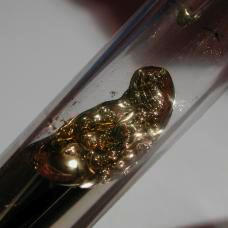
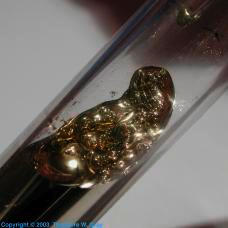
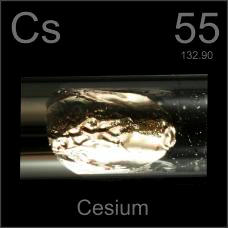
Wow is all I can say about cesium. This substance is as close to liquid gold as you'll ever see, literally melting in your hand in a matter of seconds. (Provided it's in a sealed glass ampule: If it were in your hand unprotected it would burn away your skin and flesh down to the bone, which it would probably chew up as well.) The alkali metals, of which cesium is one, react strongly with water to produce hydrogen gas, which then tends to explode (see my sodium story).
The alkali metals become progressively more reactive as you go down the periodic table, and cesium is the last, most reactive, one. (Not counting francium, which has far too short a half-life to allow it to be thrown in a lake.) While I have seen sodium exploding in water many times, only twice have I seen the far more reactive cesium and rubidium doing the same. And it turns out one time was a fake. I have personally exploded five gram ampules of all the alkali metals, producing (in partnership with Max Whitby) a series of videos for the Assignment Discovery show on The Discovery Channel. We got some nice explosions. Then I saw the British TV show Brainiac setting off two gram ampules and they got HUGE explosions, much bigger than mine. I felt bad. I wondered what I did wrong. Then I read these two articles in the highly respected Guardian newspaper: Article 1, Article 2. Shocking. Just shocking. (And my beard is not white, despite what the respected Guardian newspaper might say, as you can clearly see in this titanium sample it's just a bit, well, grayish.)
Cesium is used as the definitive worldwide time standard. The "atomic watches" you see advertised contain small radio receivers which pick up a signal broadcast from Boulder, Colorado (if you're in the US), and use it to set their time. That signal is based on the time from a cesium fountain clock operated by NIST (the National Institute for Standards and Technology).
The clever thing about using cesium is that time is actually defined in terms of cesium. The international unit of the second is defined as "the duration of 9,192,631,770 cycles of microwave light absorbed or emitted by the hyperfine transition of cesium-133 atoms in their ground state undisturbed by external fields". So you don't have to worry about what the frequency you're measuring is, you just set up an apparatus to synchronize very closely with whatever it is, divide by 9,192,631,770, and that is by definition one second.
Closer to home, reader Chris Kanter, who has been tasting various salts of chlorine to compare their taste with that of sodium chloride (table salt), reports as follows:Cesium chloride does NOT taste very good at all, and sort of burns a bit. It's very metallic in taste and has a horrible aftertaste. It's not something I think would catch on as a seasoning! :) It's fairly unpleasant. Thus, in my considered opinion after tasting several salts, sodium chloride tastes the best and I think I will stick with that!
Interestingly, cesium chloride has, for some reason, been picked by quack medicine pushers as a way of fraudulently extracting money from people who have enough problems already. It's sold as some kind of cancer cure, which of course it isn't (not that this ever stops these kinds of people). The result of this business is that you may see Google ads on this page promoting cesium chloride cancer cures. Click on them if you like: You can read some pretty wild nonsense on those sites. But please don't think for a minute that I endorse these products just because their ads appear on my page: Google's system automatically puts them here simply because I use the word cesium a lot.
|
|
| |
|
|
|
|
|
   Sealed glass ampule, 99.98%. Sealed glass ampule, 99.98%.
A quite remarkable object, it contains about a gram of 99.98% pure cesium metal.
It's really very sad that if the glass were ever to break, it could very well explode on contact with the surrounding air blinding anyone in the area with flying shards of glass and molten metal. That's why we keep it under lock and key.
Here's a picture of the locking cover, which is immediately underneath the engraved tile for cesium:
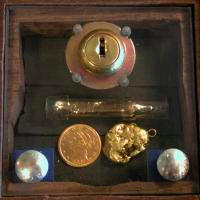
Notice there are a couple of samples of gold in with the cesium. That's because we don't have a separate locking compartment for gold right now, and also because it's interesting to see how very similar the colors of gold and cesium really are.
Source: David Franco
Contributor: David Franco
Acquired: 11 June, 2002
Text Updated: 14 August, 2006
Price: Donated
Size: 2"
Purity: 99.98%
|
|
|
|
|
|
|
Sample from the RGB Set.
The Red Green and Blue company in England sells a very nice element collection in several versions. Max Whitby, the director of the company, very kindly donated a complete set to the periodic table table.
To learn more about the set you can visit my page about element collecting for a general description or the company's website which includes many photographs and pricing details. I have two photographs of each sample from the set: One taken by me and one from the company. You can see photographs of all the samples displayed in a periodic table format: my pictures or their pictures. Or you can see both side-by-side with bigger pictures in numerical order.
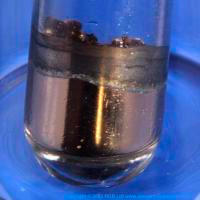
The picture on the left was taken by me. Here is the company's version (there is some variation between sets, so the pictures sometimes show different variations of the samples):
Source: Max Whitby of RGB
Contributor: Max Whitby of RGB
Acquired: 25 January, 2003
Text Updated: 11 August, 2007
Price: Donated
Size: 0.2"
Purity: 99.5%
|
|
|
|
|
|
|
Sample from the Everest Set.
Up until the early 1990's a company in Russia sold a periodic table collection with element samples. At some point their American distributor sold off the remaining stock to a man who is now selling them on eBay. The samples (except gases) weigh about 0.25 grams each, and the whole set comes in a very nice wooden box with a printed periodic table in the lid.
To learn more about the set you can visit my page about element collecting for a general description and information about how to buy one, or you can see photographs of all the samples from the set displayed on my website in a periodic table layout or with bigger pictures in numerical order.
Source: Rob Accurso
Contributor: Rob Accurso
Acquired: 7 February, 2003
Text Updated: 29 January, 2009
Price: Donated
Size: 0.2"
Purity: >99%
|
|
|
|
|
|
|
Sealed glass ampule, 99.98%.
Another beautiful cesium ampule from David Franco: He plans to offer these for sale on eBay along with a very similar rubidium ampule. The fact that cesium melts in your hand makes it one of the most fascinating element samples you can have: I never cease to wonder at the beauty of it. And the color is also quite remarkable: There are very few metals that are anything other than gray or silvery in color, so the delicate gold color of cesium is a real treat. (It's also very difficult to photograph: This picture does not do it justice.)
Just be very, very careful not to break the ampule! It will react explosively with any moisture (e.g. your hand, the air, etc).
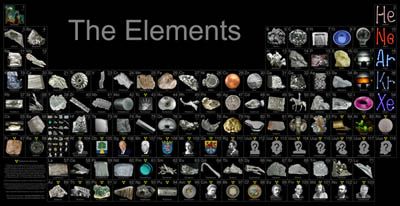
I chose this sample to represent its element in my Photographic Periodic Table Poster. The sample photograph includes text exactly as it appears in the poster, which you are encouraged to buy a copy of.
Source: David Franco
Contributor: David Franco
Acquired: 10 July, 2003
Text Updated: 4 May, 2007
Price: Donated
Size: 0.5"
Purity: 99.98%
|
|
|
|
|
|
|
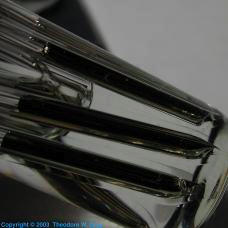
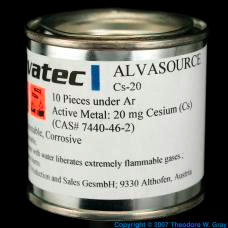
Cesium vapor sources.
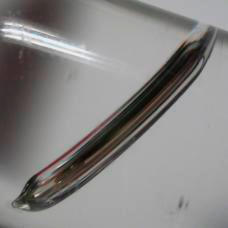
This can contains a batch of small tubes full of cesium, permanently closed at one end and sealed at the other end with a small plug of indium (see next sample for a close-up of one of them). Their purpose and design is quite interesting.
Various experiments require a source of small amounts of cesium vapor introduced into an otherwise completely evacuated chamber. Cesium is highly reactive: Exposed to air it oxidizes within seconds, so it must be kept in tightly sealed containers. The tricky part is designing a package that can be opened by remote control inside the vacuum chamber, without introducing any contamination.
These cesium sources solve the problem by using a plug of indium, which has a fairly low melting point, to plug one end of the tube. The tube has wire strips leading off both ends of it: When an electric current is applied to these leads the indium melts, exposing the cesium inside. Why indium rather than any number of other substances with low melting points, like wax for example? Two reasons: First, it's completely air-tight, allowing no diffusion of air or moisture, and completely stable in air. And second because nearly all other substances that have a low melting point also have a low boiling point, and/or are fairly volatile at normal temperatures. Wax, plastic, etc, would hopelessly contaminate the vacuum.
These operating instructions and brochure provide more details.
Source: Ethan Currens
Contributor: Theodore Gray
Acquired: 2 December, 2007
Text Updated: 23 December, 2007
Price: Donated
Size: 2.5"
Purity: >99.999%
|
|
|
|
|
|
|
|
|
|
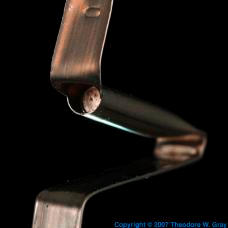
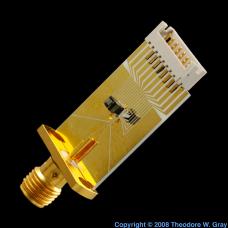
Cesium atomic clock on a chip.
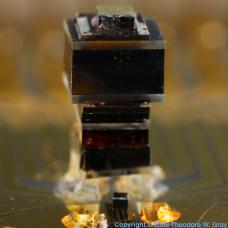
Sadly I don't actually have this device, it was only loaned to me for a day to photograph it. Normally cesium clocks are large things, like a breadbox, washing machine, or small car, depending on the model. This thing is in inch across, and most of that is just the mounting board, the clock itself is less than a quarter of an inch high and a sixteenth inch wide. In that minuscule space are contained a pair of radio antennas, a heating coil, and a glass ampule with cesium trapped inside.
This particular example is a demonstration model where the various parts are not wired up to the contacts on the supporting circuit board. This allows you to see the tower of components clearly
Thanks to James Burrus of NIST for arranging the loan of this fabulous device.
Source: NIST
Contributor: NIST
Acquired: 24 March, 2009
Text Updated: 24 March, 2009
Price: Loan
Size: 1"
Purity: <1%
|
|
|
|
|
|
|
Cesium atomic clock closeup.
This is a closeup view of the component tower in the cesium atomic clock on a chip described in the previous sample. Watch the "Spin" video to really get a good view of this thing.
Source: NIST
Contributor: NIST
Acquired: 24 March, 2009
Text Updated: 24 March, 2009
Price: Loan
Size: 0.25"
Purity: <1%
|
|
|
|
|
|
|
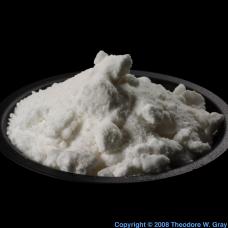
Cesium formate powder.
Cesium formate, dissolved or suspended in water, is used as a drilling fluid for drilling deep oil wells. These solutions are extremely dense, allowing them to "float" rock chips and dust to the surface from the bottom of a deep well as it is being drilled.
The "purity" figure below, 75%, refers to the weight percent of cesium in cesium formate. Because cesium is such a heavy atom, it makes up most of the weight of the compound even though the formate group contains four other atoms.
I am extremely grateful to the Cabot Corporation for very kindly sending me a bottle full of this rather expensive compound, as well as jugs of cesium formate brine and suspension.
Source: Cabot Corporation
Contributor: Cabot Corporation
Acquired: 28 March, 2009
Text Updated: 29 March, 2009
Price: Donated
Size: 2"
Purity: 75%
|
|
|
|
|
|
|
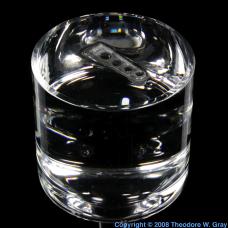
Cesium formate brine.
In the oil well industry, where this amazing liquid is used, the term "brine" refers to a clear fluid containing fully dissolved salts such as calcium chloride, calcium bromide, or if you're lucky, cesium formate. The purpose of these dissolved salts is simply to increase the density of the fluid, to make it better able to lift rock chips up from the bottom of an oil well as it's being drilled.
This cesium formate brine, very kindly donated by the Cabot Corporation, is so dense, 2.2 grams per cubic centimeter (water is one g/cc), that metal parts made of solid magnesium will float on the surface. (The density of magnesium is 1.7 g/cc.) If it were just a hair denser, 2.7 g/cc, even aluminum would float on it. Very few clear liquids are denser, one example being cesium tungstate at about 3 g/cc, dense enough to literally float rock.
What you see here is a magnesium bicycle part floating on a glass full of cesium formate brine.
Source: Cabot Corporation
Contributor: Cabot Corporation
Acquired: 28 March, 2009
Text Updated: 29 March, 2009
Price: Donated
Size: 2"
Purity: 75%
|
|
|
|
|
|
|
|
|
|
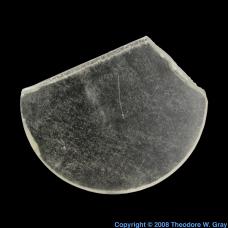
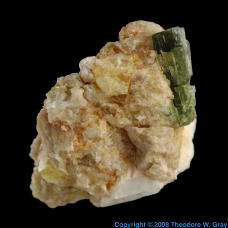
Londonite-Rhodizite.
Description from the source:
Londonite-Rhodizite serie ( (Cs K Rb) Al4 Be4 (B Be)12 028 to Rb=0 for the pure Rhodizite cub.), Antandrokomby, Antsirabe`, Madagascar. Rich in rubidium example, with Tourmaline (probably Liddicoatite). 3,1x2,5x2 cm; 22 g.
Source: Simone Citon
Contributor: John Gray
Acquired: 30 September, 2008
Text Updated: 1 October, 2008
Price: Trade
Size: 1.25"
Composition: (CsKRb)Al4Be4(BBe)12028
|
|
|
|
|
|
|
|
|
|
|
|
|
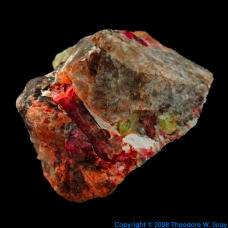
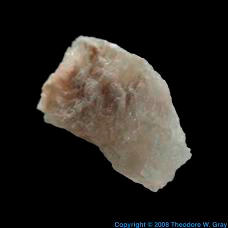
Londonite-Rhodizite.
Description from the source:
Londonite-Rhodizite serie ( (Cs K Rb) Al4 Be4 (B Be)12 028 to Rb=0 for the pure Rhodizite cub.), Antandrokomby, Antsirabe`, Madagascar. Yellow, partially translucent crystals on matrix with tourmaline. I repeat these species also for other elements, but are very interesting and rich in rare elements. 3,5x2,5x1,5 cm; 12 g.
Source: Simone Citon
Contributor: John Gray
Acquired: 19 November, 2008
Text Updated: 20 November, 2008
Price: Trade
Size: 1.4"
Composition: (CsKRb)Al4Be4(BBe)12
|
|
|
|
|
|
|
|
|
|
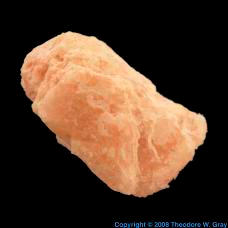
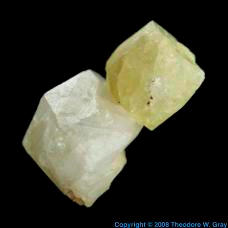
Londonite-Rhodizite.
Description from the source:
Londonite-Rhodizite serie ( (Cs K Rb) Al4 Be4 (B Be)12 028 to Rb=0 for the pure Rhodizite cub.), Antandrokomby, Antsirabe`, Madagascar. Perfect isolated crystals. 1x0,8x0,7 cm the bigger; 2 g all.
Source: Simone Citon
Contributor: John Gray
Acquired: 28 January, 2009
Text Updated: 29 January, 2009
Price: Trade
Size: 0.4"
Composition: (CsKRb)Al4Be4(BBe)12028
|
|
|
|
|
|
|
Insane mineral capsules.
These minerals capsules are called "Immune Boost 77", from Morningstar Minerals. They are either being incredibly honest, or they really don't understand what they're saying when they list what amounts to nearly the entire periodic table on the label, as the "trace minerals" they contain.
Here is the list in all its glory, typed in by my daughter in exchange for my paying for a membership in the Miley Cyrus fan club: Antimony, Barium, Beryllium, Bismuth, Boron, Bromine, Calcium, Carbon, Cerium, Cesium, Chloride, Chromium, Cobalt, Copper, Dysprosium, Erbium, Europium, Florine, Gadolinium, Gallium, Germanium, Gold, Hafnium, Holmium, Indium, Iodine, Iridium, Iron, Lanthanum, Lithium, Lutetium, Magnesium, Manganese, Molybdenum, Neodymium, Niacin, Nickel, Niobium, Osmium, Palladium, Phosphorus, Platinum, Potassium, Praseodymium, Rhenium, Rhodium, Rubidium, Ruthenium, Samarium, Scandium, Selenium, Silicon, Silver, Sodium, Strontium, Sulfur, Tantalum, Thallium, Thorium, Tellurium, Terbium, Thulium, Tin, Titanium, Tungsten, Vanadium, Ytterbium, Yttrium, Zinc, Zirconium.
Some of them are just silly, like thulium, which has absolutely no biological function. Others are a bit scarier, like thallium and thorium that are deadly poisons, and tellurium, which makes you smell of rotten onions for weeks.
Basically what they've done is list everything that occurs in even trace amounts in mixed monazite sand, which is kind of what the stuff inside looks like. The only reason they aren't seriously harmful (I assume) is that most of these are not actually present in any meaningful quantity.
My attention is drawn to these and other similar mineral supplements every time I decide to see if anything interesting has popped up on eBay for one or another of the obscure rare earths. Generally speaking if you search eBay for those guys you get very little of interest unless you turn on the option to search the text of the item description as well as the titles. Then you get lots of trace mineral supplements that one can only hope don't actually contain them.
Source: eBay seller grandma-adams
Contributor: Theodore Gray
Acquired: 24 March, 2009
Text Updated: 29 March, 2009
Price: $15
Size: 0.75"
Composition: SbCsDyErEuGdHfHoInLaLuNdPrSmScThTlTeTbTmYbY
|
|
|
|
|
|
|
|
|
|
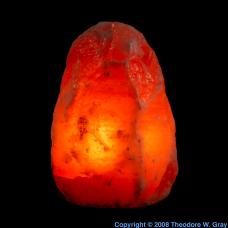
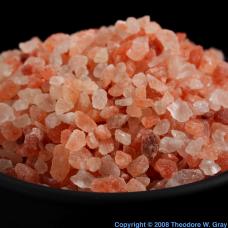
Himalayan sea salt.
There is a list of 84 elements that seems to pop up repeatedly in the ingredient lists of "natural" mineral products, supplements, pills, and the like. Even, it turns out, in salt. Here then is the list of minerals claimed to be found in all-natural organic Himalayan sea salt:hydrogen, lithium, beryllium, boron, carbon, nitrogen, oxygen, fluoride, sodium, magnesium, aluminum, silicon, phosphorus, sulfur, chloride, calcium, scandium, titanium, vanadium, chromium, manganese, iron, cobalt, nickel, copper, zinc, gallium, germanium, arsenic, selenium, bromine, rubidium, strontium, yttrium, zirconium, niobium, molybdenum, ruthenium, rhodium palladium, silver, cadmium, indium, tin, antimony, tellurium, iodine, cesium, barium, lanthanum, cerium, praseodymium, samarium, europium, gadolinium, terbium, dysprosium, holmium, erbium, thulium, ytterbium, lutetium, hafnium, tantalum, tungsten, rhenium, osmium, iridium, platinum, gold, mercury, thallium, lead, bismuth, polonium, astatine, francium, radium, actinium, thorium, protactinium, uranium, neptunium and plutonium. I wish someone would tell these people that, for example, neptunium and plutonium do not occur in nature at all, let alone in salt. Unless, I suppose, if you count nuclear fallout as a "natural" source of ingredients.
What bothers me most is what this says about the level of scientific literacy, both of the people selling the stuff, and the people buying it. Does no one actually read the list? Or do they read it an not realize how preposterous it is? It's enough to make you despair for the future of mankind.
Pretty salt, though.
Source: eBay seller saltwonders
Contributor: Theodore Gray
Acquired: 28 March, 2009
Text Updated: 4 April, 2009
Price: $15
Size: 0.25"
Composition: NaClSbCsDyErEuGdHfHoInLaLuNdPrSmScThTlTeTbTmYbY
|
|
|
|
|
|
|
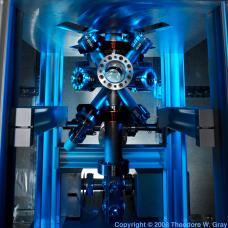
Cesium clock F1. (External Sample)
This a photograph of F1, the master cesium atomic clock at NIST in Boulder, Colorado.
Location: Boulder, CO
Photographed: 17 April, 2009
Text Updated: 1 November, 2009
Size: 100"
Purity: <1%
|
|
|
|
|
|
|
|
|
|
|
|